Showing posts with label Chyulu Hills. Show all posts

Wednesday, January 14, 2015

Introducing... the Volunteer Safari!

Would you like to effect positive change as you travel?  Why not volunteer on vacation?  The Maasai Wilderness Conservation Trust and Campi ya Kanzi are thrilled to introduce the new volunteer safari!  Guests are invited to volunteer with MWCT for three weeks while also enjoying a discounted stay at Campi ya Kanzi.  These guests will receive the same five-star treatment that Campi ya Kanzi is known for while also making a difference for the local Maasai community.

Are you ready to put your talents to use?  By traveling to the Chyulu Hills and the Maasai-owned Kuku Group Ranch, you can support the local economy while also helping to protect the wildlife and people who live here.  Make an impact in the areas of conservation, education, and health as you immerse yourself in the colorful Maasai culture and explore the unspoiled wilderness of the Amboseli-Tsavo ecosystem.  During your stay, you will live in a luxurious tented cottage, enjoy Italian cuisine at Tembo House, and split your time between safari and volunteer activities.  Spend the morning teaching a science lesson to local Maasai schoolchildren, then take a game drive and watch the sun set over Mount Kilimanjaro with a refreshing gin and tonic.  Vacation for a good cause and enjoy the trip of a lifetime as you promote positive change for the Maasai.  Read on to learn how you can help.

 
Maasai Wilderness Conservation Trust
  
The Maasai Wilderness Conservation Trust is a non-profit organization in southern Kenya that works to protect wilderness, wildlife, and culture across the Amboseli-Tsavo ecosystem through projects that directly benefit the local Maasai community.  MWCT has developed conservation, education, and health programs which demonstrate that the Maasai can thrive by managing their environment wisely.  MWCT employs nearly 250 Kenyans and serves a population of 17,000 Maasai.  To learn more about MWCT, visit www.maasaiwilderness.org.
   
How You Can Help 
      
Conservation
        •    Assist with wildlife counts
        •    Accompany MWCT rangers on their monitoring patrols
        •    Place camera traps in various locations and analyze their photo data of wildlife
        •    Teach lessons about the environment in local primary schools


Health
        •    Participate in health outreach events
        •    Assist the doctor at a local health clinic
                    o    Help with infant check-ups and immunizations
                    o    Record patient data in medical files
                    o    Assist with the dispensation of medicine at the pharmacy
        •    Give health talks in local primary schools
                    o    Possible topics include HIV/AIDS, puberty, and substance abuse


Education

        •    Teach guest lessons at a local school in the subject of your choice
        •    Assist the librarian at the Iltilal school library
        •    Help the teachers to prepare lessons, worksheets, and PowerPoint presentations


Other
We value the specific talents that you bring to MWCT.  Tell us about your skill set so we can put it to use in the best possible way.
        •    Are you an artist?  Paint a mural at a local school or health clinic.
        •    Are you a botanist?  Assist the conservation team with rangeland monitoring.
        •    Are you a photographer?  Take pictures for our website and social media platforms.
        •    Are you a blogger?  Write about your volunteer experiences on the MWCT blog.

Ready to sign up?  For more information, contact bookings@maasai.com.

Tuesday, December 9, 2014

Education Program Update - End of Term One at Kanzi Academy

Term One has ended at Kanzi Academy, and with it a successful season of learning and discovery.  As the welcome rains of November transformed the savannah from dusty yellow to lush green, the students enjoyed trekking in the Chyulu Hills and exploring the great outdoors.  The Kanzi teachers recognize the exceptional opportunities afforded to a school in the bush and incorporate nature into their lesson plans, building a learning environment that utilizes both the classroom and the world outside.  Experiential learning is key at the Academy, where students strive to understand their role in the community as well as their relationship with the environment.

Class One lines up for a hike in the Chyulu Hills.
 
In the second half of the term, Class 3 explored the theme of "leadership" in spiritual education class, addressing such probing questions as "What makes a good leader?"  Responsibility, trust, connection, tolerance, and empathy were all discussed in detail through debates and moments of reflection.  The facets of leadership were also demonstrated in fun, practical activities such as the "banana operation."

The students continued to benefit from advanced technology in the classroom, utilizing both laptops and a state-of-the-art SMART Board.  These tools enhance the learning experience and prepare students to succeed in an increasingly digital world.
 
Class Three hard at work on their laptops

Kanzi Academy students use interactive technology to complement their lessons.
  
The students enjoyed a musical treat when violinist Barbara Stoddard performed a private concert at the Academy.  The children learned about the parts of a violin, the bow, and the tuning process and also listened to different styles of music.  Meanwhile, in art class, the students had a great time making bracelets and "Kanzi Bears."
 
Students made "Kanzi Bears" as a craft project.
   
At the end of the term, the students got into the Christmas spirit by decorating the Christmas tree at Campi ya Kanzi's Tembo House.  The savannah-themed tree is decked with lions, zebras, giraffes, gourds, and small African dolls.  As the students and teachers head home for the holidays, they wish a joyous season of celebration to all!
 
Merry Christmas from Kanzi Academy!


Sunday, October 26, 2014

Conservation Program Update - Rangeland Management Plan

The MWCT conservation team recently conducted a rangeland baseline survey in Kuku Group Ranch to assess grass cover.  Results of the survey showed that most of Kuku Group Ranch suffers from low grass cover and overgrazing.  MWCT will combat this problem by developing a participatory rangeland management plan in partnership with the local Maasai community.  This plan will aim to  prevent overgrazing, to reduce erosion, and to increase productivity of semi-arid land.

Rangeland baseline survey results: This map of Kuku Group Ranch shows the percentage of grass cover in the different rangeland survey plots. The number indicated above each pie chart is the measured percentage of grass cover in that specific plot.


Richard Hatfield and John Oitaos of Natural Capital East Africa are collaborating with MWCT to develop the rangeland management plan.  In mid-October, Richard, John, and the MWCT conservation team held a three-day workshop to lay out the details of the plan to the community.

John Oitaos from Natural Capital East Africa taught Kuku community members
about the different mechanisms of a holistic grazing management plan.

MWCT is also setting up a grass seed bank near the town of Kuku to reintroduce grass to an overgrazed area and to produce grass seed that can be sown in other areas.  A Maasai women’s group will be engaged to manage the area and to harvest and sell the seeds.  In this way, the project will empower local women, build their capacity in the community, and provide them with income through grass seed sales.  Because animal husbandry is essential to the Maasai way of life, MWCT is partnering with the community to improve rangeland management and to secure a healthy future for the pastoralist community.

The contrasting rangeland conditions on Kuku Group Ranch: Overgrazed rangeland in Samai (left)
and the healthy rangeland in the Chyulu Hills (right).

Saturday, July 26, 2014

Conservation Program Update: Nanumyak Helps to Recover Ivory!

Some really wonderful news from our Conservation team! We had noticed that one of our female collared lions Namunyak had not moved for 2 days, as seen on our GPS map. She had been up in the cloud forest high up in the Chyulu Hills in one position. We were slightly uncomfortable with it and feared that she might been caught in a poachers snare or that something had happened to her.

The beautiful Namunyak (right)

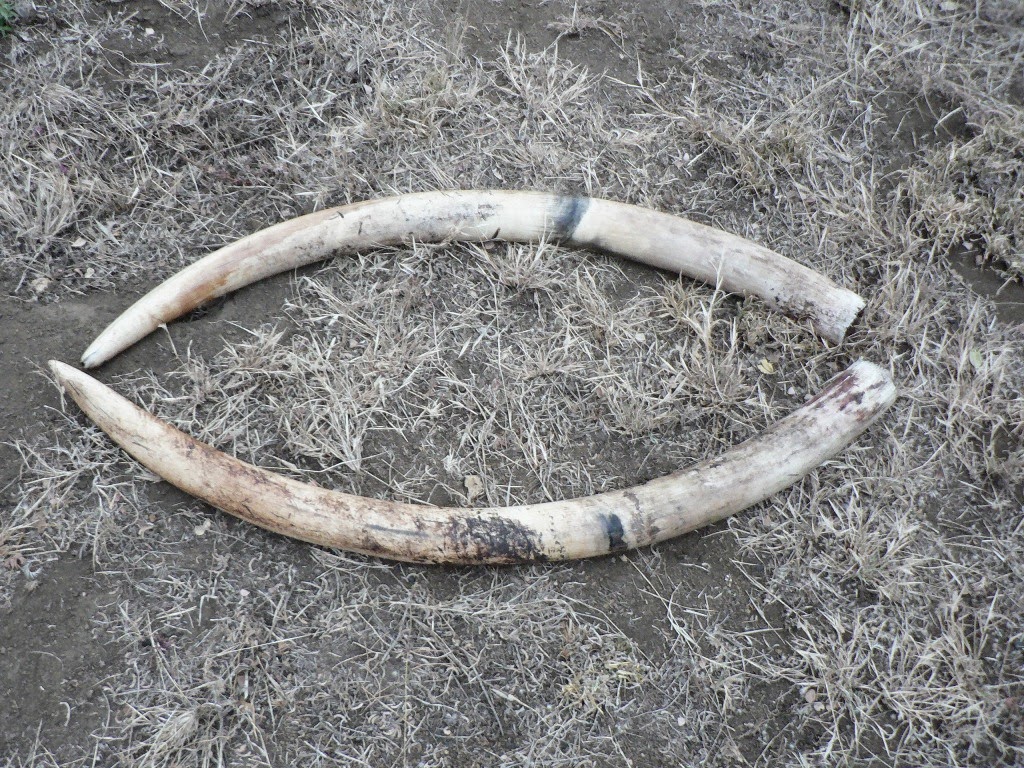
So we arranged an operation one morning last week with the rangers and tracked into the forest to the place we last received a GPS location point from her collar. Once we got to the place we smelled a carcass... and heard a soft growl a couple of metres away in the dense bush. On closer investigation we found it... a carcass of a big elephant! We were so relieved to know that Namunyak was actually doing just fine and that the reason for her t be in one position for two days was because she and her group were feasting on an elephant carcass!

Head Ranger Muterian with the removed tusks

The carcass was about a week old and already partially eaten by the lions so we could not determine the cause of death. It is unlikely that Namunyak and her group killed it. However, the tusks were still intact so we removed them to hand over to Kenya Wildlife Service.


This is just another example that we are very proud of to emphasize how the lion collars assist us in our day to day conservation work!

Tuesday, July 15, 2014

Conservation Program Update: Public Comment Period - Chyulu Hills REDD+ Carbon Project

MWCT has recently started a REDD+ (Reducing emissions from deforestations and forest degradation) Carbon Project. The REDD+ mechanism has been introduced by the United Nations as a climate change mitigation strategy. The goal of a REDD+ project is to prevent deforestation and forest degradation by active forest protection and provide alternative livelihoods for local communities living in and around the forest area.

For the Chyulu Hills REDD+ Carbon Project, MWCT is working in collaboration with 8 other conservation organizations (Conservation International, African Wildlife Foundation, Big Life Foundation, Wildlife Works, David Sheldrick Trust, Forestry Service, Kenya Wildlife Service, Kari Kiboko) to protect the forests and woodlands in and around the magnificent Chyulu Hills, referred to by Ernest Hemingway as the "Green hills of Africa".

The Chyulu Hills
The Chyulu Hills REDD+ carbon project encompasses an area of 4105 kilometres squared and includes 3 Maasai owned Group Ranchers (Kuku, Rombo and Mbirikani), Chyulu Hills National Park, a section of Tsavo West National Park, Kibwezi Forest Reserve and the Kari-Kiboko research area. The Chyulu Hills REDD+ carbon project is unique in that it is not only protecting the forests and woodlands, but it also protects a vital watershed.

The Chyulu Hills have a relatively higher rainfall than the surrounding areas and form a crucial water source in the further arid to semi-arid environments. The cloud forest that grows on top of the hills even collects water by cloud condensation on the leaves of the trees, the mosses and ferns during the dry season. Furthermore, the Chyulu Hills consist of highly porous volcanic rock causing most of the water to immediately infiltrate and create underground rivers. These rivers emerge in the form of springs all around the Chyulu Hills, where volcanic soils meet solid basement rocks. The most well-known of all these springs are the Mzima Springs in Tsavo West National Park. Here, an astonishing 190 million litres of water a day emerges from underneath the rocks. A pipelines transports part of this water to the human population in the costal area of Kenya. In this way, 40% of the freshwater in Mombasa originates from the Chyulu Hills.

There, the disappearance of the forest on top of the Chyulu Hills would not only have disastrous effect on the surrounding Tsavo-Amboseli ecosystem and its human population, but also on the human population further away in the coastal province of Kenya.

Since the project started, the biomass plot sampling (to assess the total amount of carbon currently present in the project area) has been completed as well as the FPIC (Free Prior and Informed Consent) process. For the FPIC process, several community outreaches were held across the project area in order to inform the community about the project and seek their support. MWCT was responsible for the outreaches on Kuku and Rombo Group Ranches and conducted a total of 25 FPIC outreaches.

The FPIC (Free Prior and Informed Consent) outreaches conducted by MWCT's outreach officer 

In June, the Project Design Document has been completed and is now open for public comments on the CCB website until 27th of July. All comments, positive remarks, constructive criticism or simple suggestions, are welcome!

Please visit: http://www.climate-standards.org/2014/06/25/chyulu-hills-redd-project/

Wednesday, July 9, 2014

Conservation Program Update - Lion Collaring Update

It was a quiet and crisp morning, end of June as the Simba Scouts headed out on foot at daybreak to track lions. They heard the roaring the night before and were determined to find them. The pressure was on since the previous collaring attempt in April, where we went out for three full nights, and without being successful. This time we had to succeed!

Tracking the lions!
It was not long before the Simba Scouts found fresh tracks of 7 lions! They followed these tracks for a couple of kilometres up to a dense thicket in an area known as Eluai, just south of Iltilal village. The Simba Scouts decided to look around the thicket to see if there were any lion tracks coming out of the thicket. After searching for a while, and not finding any tracks apart from the ones heading into the thicket, they concluded that the lions must still be inside, resting. Lions often use dense thickets or lava forest patches on Kuku Group Ranch as a refuge during daytime to avoid contact (that may lead to potential conflict) with people and their livestock.
Conservation Coordinators Lana and Dirk work to hang the carcass in the tree
After receiving this information the plan was clear... conduct a calling station that evening in the vicinity of the thicket.
The vet busy preparing for the long night of collaring
At 4 pm, the collaring team headed out to scout the area and to prepare for the nights calling station. As the last rays of the sun disappeared behind Kilimanjaro, we started with the nights operation, starting with the distressed call of a warthog (pig squeal). Soon after, the silhouette of a lioness appeared... followed by another... and another... and another! Until all 7 lions (2 adult females and 5 sub-adult cubs) were there sitting and watching us curiously from behind a bush a couple of metres away! Our hearts started beating with anticipation as we waited for the vet to get into position to dart one of the adult females. A few minutes went by (which felt like hours) and then the call of the vet came over the radio telling us that he cannot get a clear shot on either of the two adult females from his position as they were obstructed by the bush. He did not want to take a chance and miss as this can only scare them off, so he decided to rather wait patiently for them to come closer to where the carcass was hanging in a tree next to his car.

To our disappointment, the lions lost interest and moved away! However, they stayed in the vicinity. We watched them through the night vision equipment playing and grooming one another. After some time we changed the sound to that of a buffalo calf in distress. This triggered again the interest of the lions and they made several attempts to approach us. After about 2 hours, one of the lionesses stood up and came directly to where the carcass was! It was perfect, and right next to the car of the vet!

Working to fix the collar and take measurements of the newly collared lion!
We are very delighted to introduce to you our newest member of the Kuku lion family - Neluai! Named after the area Eluai where she was collared! She is approximately 5 years old and in excellent condition. She has, since the collaring, visited our waterhole at CCRC several times and has been seen frequently with her group. Recently she has been spotted alone at our waterhole with a big male lion. We suspect Neluai to be mating with him!

Watch this space for more exciting news on our collared lions!

Neluai and a large male visit the water hole at CCRC
She is doing well! 

Thursday, June 5, 2014

Conservation Program Update - Aerial Game Count 2014

Kuku Group Ranch lies in the heart of the Amboseli-Tsavo ecosystem, and covers 1133km squared. It is an important conservation area for wildlife and critical ecosystem services, protecting crucial water resources from Mount Kilimanjaro and the Chyulu Forest, which supports millions of people across Kenya for water needs.
Kuku Group Ranch location in Kenya
Understanding wildlife and livestock distribution and abundance on Kuku Group Ranch (KGR), and being able to monitor trends and changes over time, is an important part of being able to develop appropriate conservation management strategies. Therefore, aerial surveys were started on KGR in 2010 as part of a long term monitoring plan.

This will provide valuable information to enable the monitoring of trends in the distribution and abundance of wildlife and livestock on KGR providing a basis for monitoring ecological changes and patterns of human use over time. A longterm dataset will enable MWCT to monitor major patterns of abundance and distribution of certain wildlife species in particular in relation to habitat and human presence and disturbance. The results will provide information to identify areas of conservation, which will guide conservation management.

The 2014 Game Count team after a very long day of hard work!
Fuelling the aircraft mid-day
In general, there has been an increase in wildlife as well as livestock numbers over the past few years since the drought of 2009. The most abundant wildlife species found on Kuku Group Ranch during the aerial survey of 2013 was the Burchell's zebra, followed by gazelle, Maasai giraffe, and Impala. The results of this year's aerial survey will be compared with the previous years.

Tuesday, December 24, 2013

Running for the Maasai - A Post by Mark Somen

Maasai Wilderness Conservation Trust board member, Mark Somen, chose to share his personal thoughts with us regarding the New York Marathon that occurred this past November. Read about it here!

Running for the Maasai:


I remember marvelling at the fact that 3 Maasai's ran the NY Marathon with shukas and all, in 2009 - accompanied by Luca Belpietro and Edward Norton. I ran my first New York Marathon in November with the team from MWCT. I wanted to share some things that really stood out for me. This was my second marathon - the first being the Safaricom (Lewa) Marathon in Kenya.

STAND OUT #1 - the crows of supporters in New York are famous. The crowds at the Lewa Marathon, well, lets say for much of the route the giraffe outnumbered the humans. So I was expecting huge crowds through New York, but nothing prepared me for the volume, intensity and passion that the crowd brought with them.

STAND OUT #2 - As some of you may know, we flew Jacob Lamaron out from the Chyulus to run with us and for the 2 days before the race, we walked Jacob around the streets of Manhattan. Jacob was dressed somewhat traditionally - and Stand Out 2 was the number of people stopping him to take his picture. Really? I though New Yorkers just dealt with all things unique and unusual...

STAND OUT #3 - pre Marathon party. Modo Yoga, Dina T the yoga instructor, DJ Kylie T, Health Warrior and the fabulous Melissa Chmelar from Spoon - all donating time/food/energy and great spirit to make the party happen; as well as numerous other people. When I think of the fact that we are 7000 miles away from the Chyulu Hills in New York City - and there are all these people who care passionately about MWCT - it humbles me. I am Kenyan, I am on the board of MWCT, I love what is happening there, and love Luca, Antonella and the extended family there - so in a way, I should be doing something. But these random other people - why are they making this a priority? The evening at Modo Yoga and the deep sense of community, sharing and togetherness will say with me for a long time. And the pride that I feel being a part of MWCT hopefully will stay with me forever.

STAND OUT #4 - my immense sense of gratitude. Finishing that distance made me feel amazing, but in no way did I feel it was only ME. The hundreds of thousands of New Yorkers and visitors that carried me though the distance and my many friends who sponsored me to reach my goal of $5000 for my charity. My Italian Maasai friends Luca and Antonella who got me into this incredible family called Campi ya Kanzi and MWCT, my New York (Japanese) running buddy, my best friend who was there practically every step of the day, and of course my lovely wife Yassi and kids. Yassi and the kids for putting up with my never-ending training, as well as giving me that boost just before the 59th St Bridge - boosting me over the bridge and through the second half of the marathon. I am so grateful to you all!

And so my mind turns to the upcoming year, to the next Yew York Marathon, and the words of Nelson Mandela:

"When people are determined they can overcome anything"

I think about the beautiful Chyulu Hills with all the challenges: filling the camp, having enough water, protecting the wildlife, building more schools and clinics - the list goes on. Running 26.2 miles seems like a task that is relatively easy to overcome, when you put it into perspective...

Thursday, November 14, 2013

Conservation Program Update - New Lion Collars

Kuku Group Ranch, 1133 squared kilometres of communally owned Maasailand, is situated in the heart of the Tsavo-Amboseli ecosystem in Kenya, and acts as a critical wildlife corridor between Amboseli National Park, Tsavo National Park, and the Chyulu Hills National Park. It is crucial for maintaining healthy populations of wildlife and preserving ecological processes.

On Kuku Group Ranch, lion-livestock conflict is considered to be one of the most important threats to the lion population. The increase in human population density results in an increased frequency of contact between people, their cattle and lions. This causes intense lion-livestock conflict that consequently leads to the retaliatory killing of lions. 


The main objective of the MWCT Lion Project is to study the lion's social structure, its' home range and movements, habitat use and diet on the community land. Four new lions will be collared with GPS satellite collars and the diet will be determined using the GPS clusters method. The behaviour and movement of lions in respect to human settlements, water points and livestock will be investigated. More detailed information could help us find ways to more effectively mitigate the human - lion conflict and help us conserve this lion population in Maasailand. 

Lion conflict with people and their livestock has been a serious cause of lion population decline, especially in Maasailand, and therefore it is critical that local communities living with lions are incorporated into lion conservation measures. The Maasai communities who share their land with lions are critical stakeholders in ensuring their long term conservation and MWCT is working with the community to reduce the costs of living with wildlife, while demonstrating benefits derived from lions and other wildlife. This in turn can improve the lives of Maasai people and can be a key contributing factor to ensuring the long term survival of lions in Maasailand.

MWCT Simba Scouts with the four new lion collars!
MWCT has just recently obtained these four new lions collars. The collaring exercise has been planned for the end of November (weather permitting of course).

We would like to extend a word of thanks to the sponsors of these four new lion collars - Apple Inc. via Shari Overstreet (a CyK guest) whom agreed to have CyK conservation feeds and the matched dollars by Apple Inc. put towards the purchasing of these collars; as well as all guests of Campi ya Kanzi as their daily paid conservation fee significantly contributes to the successful outcome of this Lion Project.

Furthermore, through MWCT's crucial eco-tourism partner, Campi ya Kanzi, MWCT is able to utilize surcharges on visitors to CyK to fund Wildlife Pays, a program that compensates livestock herders for losses to wildlife predation. This occurs through a rigorous system of certification and monitoring of best practices. Maasai livestock owners are paid quarterly for value of losses in exchange for full protection of predators throughout the Group Ranch.

The Campi ya Kanzi conservation fee paid by guests significantly cover the annual compensation costs, establishing a sustainable model of Payment for Ecosystem Services (PES) around the protection of wildlife, and further emphasizing the importance of the relationship between Campi ya Kanzi and the Maasai Wilderness Conservation Trust. 

Wednesday, November 13, 2013

Education Program Update - Sharing Inspired Stories

Tiffany Franke visited Campi ya Kanzi and the Maasai Wilderness Conservation Trust on behalf of the United Nations Development Program. During her visit here on Kuku Group Ranch, she was inspired greatly by the efforts of MWCT, its' programs, the staff, and the local Maasai community members.

Tiffany eloquently gives both praise and understanding to the works and efforts of the Trust and Campi ya Kanzi in her video and posts that she has published on her blog. During her stay with us, Tiffany was witness to all of the programs offered through MWCT, but states that she was most impressed and influenced by the actions of our Education Program - more specifically the Kanzi Academy.

Kanzi Academy students on a walk in the Chyulu's with Tiffany
The Kanzi Academy is a very important project that is contained within out MWCT Education Program. Kanzi Academy, a private boarding school run by the Maasai Wilderness Conservation Trust, has chosen the most talented students from Kuku Group Ranch to attend. The Academy commits to exposing these students to educational opportunities that not entirely available to many other children living on the Group Ranch.

The Academy instills in its' students the importance that should be laid on the local culture and its valuable environment it is contained within. As is stated in Tiffany's video provided here, "the Kanzi Academy represents potential being recognized", and that "in order to have a successful community, you need to have good leaders rooted from good education" (quote by Antonella Bonomi).

Tiffany chose to share her story with us, and we are so happy that she did. 

Please follow the link below to hear Tiffany's story and her impressions of MWCT and Kanzi Academy during her time here in the Chyulu Hills:


You can also find blog postings that Tiffany chose to share about the Kanzi Academy students; as well as her thoughts on the Team at MWCT and Campi ya Kanzi.

Monday, October 28, 2013

Education Program Update - An Amazing Donation

October 16, 2013 marked a very exciting day for Campi ya Kanzi, and the Maasai Wilderness Conservation Trust Education Program!

Elizabeth and Ramsey from the United States have been staying at Campi ya Kanzi for the past week. Elizabeth found Campi ya Kanzi and the Maasai Wilderness Conservation Trust due to her extreme passion of wanting to understand the elephant poaching epidemic, along with its effects in Kenya. Her mission to be of aid to the elephants of Kenya is inspiring, and if you are interested in learning more about her story, please visit her blog here.

Iltilal Primary School
Before Elizabeth and her husband Ramsey made the journey to Kenya, Elizabeth hosted a gathering in her home. Twenty-seven women gathered to learn through Elizabeth about the elephant poaching crisis in Kenya, in regards to the ivory demands and its everlasting negative effects on the species and to the ecosystem. Elizabeth also shared with these women the information that she gathered from conservation trusts that are key stakeholders in the elimination of elephant poaching - the Maasai Wilderness Conservation Trust being one of them. 

Elizabeth also provided those in attendance of her presentation a donation request list. The purpose of these donations would be to support the Education Program of the Maasai Wilderness Conservation Trust, and more specifically, The Kanzi Academy. 
Samson with the unbelievable donation of school supplies!
We cannot express enough gratitude to Elizabeth and Ramsey, for not only travelling across the world with 3 massive bags of school supplies, but for expressing such support and gratitude towards our programs here, and for inspiring immense generosity in others. 

Wow!
The donation is absolutely outstanding. The total number of items donated totalled approximately 14 000 items. Just unbelievable. The school supplies included were:

2 560 pieces of construction paper, 2 160 pieces of notebook paper, 1 204 crayons, 362 regular pencils, 170 coloured pencils, 136 colour markers, 100 stickers, 99 erasers, 88 glue sticks, 80 pencil sharpeners, 75 dry erase markets, 69 ballpoint pens, 21 sets of math flashcards, 20 pairs of scissors, 13 rulers, 11 pencil cases, 8 alphabet flash cards, 7 letter practice pads, 6 paint sets,  5 nature, science, space, history reference books, 5 sets color & shape flash cards, 5 puzzle and crossword books, 4 dry erase learning boards, 4 calculator sets, 2 backpacks.
Elizabeth and head teacher, Catherine, meet in the courtyard of Iltilal Primary School
Due to the overwhelming amount of supplies, it was believed it would be most beneficial if the supplies were split between four different schools within Kuku Group Ranch. One of these schools being the Iltilal Primary School. This school, with 861 school children from grades Nursery - Grade 8, were extremely welcoming to Elizabeth as she brought a large bag of school supplies on her visit!

School children in Grade 6 beam with excitement when catching a glimpse of the supplies!
The donated items were all of tremendous quality and will ensure sustained use in these schools for years to come
Head teacher Catherine displaying some of the items to her class!
Iltilal School demonstrated extremely gratitude towards Elizabeth during her visit!
The generosity of our guests at Campi ya Kanzi is immensely appreciated. Asante sana Elizabeth and Ramsey, your donation and support has contributed to the aim and objectives of the partnership between Campi ya Kanzi and the Maasai Wilderness Conservation Trust and we are forever grateful!

Tuesday, October 22, 2013

MWCT Ambulance Success Story!

Recently, here at MWCT, we had the opportunity to give a presentation to some special guests, hosted at the Chyulu Conservation and Research Center. Stories of our Conservation, Education, and Health Programs were shared and discussed throughout the afternoon.

Our Health Program Development Director, Lena Koh, shared a wonderful success story with those in attendance at the presentation in regards to our ambulance!
Our ambulance "Anna"

Our ambulance was donated to MWCT in 2012 by Anna Kulidjian. The unit was a tremendous addition to the Health Program, as has further allowed for expanded reaches of medical capabilities, and rapid transport of extremely sick patients which were tasks that were nearly impossible without the use of this vehicle. It has proved tremendous convenience for the Maasai in Kuku Group Ranch thus far.


It's uses became specifically crucial for one particular medical emergency that occurred last week. On October 16 at 4 p.m., a local Maasai woman was brought to the Iltilal Health Centre by her mother in law and traditional birth attendant. This pregnant woman was having contractions for the previous four hours in her home. Upon arriving to the Centre, MWCT medical staff did a physical exam, palpitations, and a vaginal exam (VE). Upon performing these exams, they realized that it was a cord presentation. This can occur during pregnancy when the umbilical cord descends before the fetus prior to delivery. It is a definite obstetrical emergency and requires a immediate emergency cesarian section - if a natural delivery were to take place, the baby would must likely suffer from hypoxia and it would be fatal).

Our ambulance was dispatched immediately and the MWCT Health team rushed to Loitokitok district hospital (over 50 km on dirt road and averages over and hour driving time). The ambulance, the team, and the woman made it to the hospital in record time (less than one hour, while driving through military road blocks with sirens on) - and the medical staff at the maternity unit were ready and on hand to receive the woman. The team worked together to prep the patient for surgery and then she was rushed into the theatre. The emergency c-section was performed. The baby had to receive resuscitation due to his severe distress, but he was successfully saved! Staff stated that if the surgery was delayed any longer, the baby would not have survived.

View of the inside of our ambulance
It is stories like this that are shared and further place tremendous importance on the support that is given to MWCT, and certainly in regards to the donation of our ambulance. It's services have continued to provide extraordinary emergency assistance to community members and we are very proud of this particular success story.

Our ambulance servicing many villages located within Kuku Group Ranch