Showing posts with label lion. Show all posts

Thursday, March 19, 2015

The 2014 Maasai Olympics: Competing for Change

The 2014 Maasai Olympics took place in mid-December, hosted at Kimana Sanctuary in Kajaido, Kenya. Organized and sanctioned by Big Life Foundation, the Maasai Wilderness Conservation Trust, worked together with  a number of other supporters, sponsors, and and contributors in collaboration to bring together warriors of Kuku, Rombo, Mbirikani, and Olgulului Group Ranches to compete in six different events; rungu throwing, spear throwing, high jump, 200 m sprint, 800 m sprint, and 5 kilometre run.

A moran competes in the high jump competition
The sole purpose of the Maasai Olympics is not only to provide the current warrior age set with a platform to compete with their peers, but more importantly, to emphasize an alternative to the traditional practice of proving manhood - lion killing. This platform was provided to the warriors to utilize traditional skills to "hunt for medals, not for lions".

Gold, Silver, and Bronze Medals
The first competition in 2012 was deemed a huge success, and 2014 was certainly an exciting competition!

Participants of the 5000m competition
The Maasai Wilderness Conservation Trust sponsored the 1st position of the 5000m and 800m to participate in the New York Marathon. The 5000m was a very tense competition... as Kuku was for a large part of the race in the 1st, 3rd, and 4th position. In the last 300m a moran from Mbirikani who was in the 2nd position overtook the Kuku runner and ended up winning the race!

Samson handing over cheque to the winning moran to participate in the 2015 New York Marathon
Overall score of the Olympics: 1st position Mbirikani Manyatta with 16.5 points; 2nd position Olgulului Manyatta with 7.5 points; 3rd position was Kuku Manyatta with 7 points (very close call between 2nd and 3rd position) and in the 4th position was Rombo Manyatta with 5 points total.

Kuku was proudly in the 1st position for Javelin (spear) throwing!


It was an excellent day filled with an extraordinary display of skill, competition, cooperation, and commitment to conservation. To learn more about this tremendous event, you can visit the official Maasai Olympics website here


MWCT Ranger with David Rudisha - Kenyan Gold Medalist

The Scoreboard

Sunday, August 10, 2014

MWCT Celebrates World Lion Day 2014!


The Maasai Wilderness Conservation Trust joins the rest of the world in celebrating World Lion Day on August 10, 2014! 

As we are all unfortunately aware, the global lion population is decreasing rapidly across the continent of Africa. Throughout Kenya, communities and organization are working incredibly hard to mitigate issues and increase protection of such an iconic species to the country, and its' people. It was made very clear to Campi ya Kanzi and MWCT that their help is continually needed to ensure that lions will be in existence for generations to come!


The Maasai Wilderness Conservation Trust is finding dedicated ways to contribute to a holistic strategy in addressing increasing threats to such a vulnerable and crucial keystone species.

Specific increasing pressures are growing on the lion population, particularly on community owned Maasai land, the case for the lions resident of Kuku Group Ranch in southern Kenya, where MWCT is operating its' efforts. As the human population grows worldwide and in Kenya, lions are threatened by habitat fragmantation from human development; lack of natural prey base on the particular community land due to migrant movements to National Parks; and direct prosecution - such as the traditional ritual of lion hunting in Maasai warrior culture.


MWCT is holistically approaching these above threats through various means. By protecting vital habitats through the creation of conservancies (tourism partner Campi ya Kanzi is located entirely in its' own conservancy), combating issues like poaching with strategic anti-poaching teams and patrols, hiring and positioning wildlife monitors across the Group Ranch (particularly young Maasai moran Simba Scouts acting to keep an eye on the lions), providing environmental education outreaches to communities, as well as pioneering a wildlife compensation program, Wildlife Pays, to combat retaliation of predation on traditional livestock.


MWCT and Campi ya Kanzi are proud to say that these above strategies have continued to incentivize the Kuku Group Ranch community to appreciate wilderness with thriving wildlife as a resource to them. The lion population on the Group Ranch is a very healthy 38! We have collared 5 lions on the Ranch, allowing us to further actively protect and monitor their continued activities.

Thursday, August 7, 2014

Conservation Program Update - Quarterly Success

Our Conservation Team has compiled its' quarterly successes and accomplishments to share with you on our blog! Enjoy reading up on the following tremendous accomplishments from the past couple of months!

Community Rangers:

A deceased elephant was found by 2 school boys herding goats. The school boys immediately informed MWCT Community Rangers about the elephant. The rangers went to the site and found a fresh carcass of an elephant with its tusks still present. MWCT Rangers removed the tusks and handed it over to KWS in Komboyo. After a post mortem was completed, it was determined the death was due to a poisoned spear, which suggests poaching. MWCT Rangers are now investigating the incident!

Our Rangers were informed by a community member from Inkisanjani about poachers planning to poach wildlife on Kuku Group Ranch. The rangers managed to successfully set an ambush and captured 2 of the 3 poachers and impounded 2 motorbikes and bushmeat.

Map of Kuku Group Ranch indicating the patrol effort and areas covered by the different ranger sectors during their security foot patrols from April to June 2014
Lion Monitoring & Simba Scouts:

During this quarter, a detailed lion population survey was conducted! The current estimated resident lion population on Kuku Group Ranch is 32 (14 adults and 18 sub-adults/cubs)!

Namunyak in the company of two adult lionesses and cubs

Of these, 5 lions are collared. These lions are monitored closely by the Simba Scouts on a daily basis. In the event that one of these lions moves into an area close to livestock or bomas, the Simba Scouts will warn the community and herders to watch out and avoid these areas in order to prevent conflict which may lead to the retaliatory killing of lions! A wonderful tool for us!

Lion movement of the 2 GPS collared lion (Yellow = Namunyak; Pink = Neluai)

Wildlife Pays:

Our Wildlife Pays Program this quarter was very busy! A total of 259 incidents of livestock predation were recorded; most incidents being due to hyena, followed by cheetah and then jackal. The total value of the payout was 1,552,400 Ksh.

Number of heads of livestock killed per wildlife species in this past quarter
Community Outreach:

Wildlife Pays Outreach - In these meetings, MWCT's program coordinators spoke to the community about the benefits that MWCT is giving to the community, and their role in protecting their natural resources and wildlife in turn!

MWCT and Campi ya Kanzi Staff Meeting - A meeting with all of the staff of both organizations was held at the beginning of June. During this meeting, the achievements of 2013 were announced and future MWCT projects and goals were discussed

Environmental Education Outreach in Inkisanjani and Olkaria - MWCT Outreach Officer, Joseph Lairumbe, went to Inkisanjani and Olkari Primary School to give an environmental education lesson (Know Your Wildlife) to the school children. These lessons were attended by 200 and 250 pupils respectively! The children greatly enjoyed learning about wildlife - and they were encouraged to protect the wildlife and other natural resources in their area

Moran Chief Initiation Ceremony - On the 3rd of May, Peter ole Sombol, was initiated as the leader of the Maasai warrior age-set from the Iltilal Manyatta. MWCT Program Coordinators and Management attended the ceremony and had a brief meeting with the new chief after the ceremony. Peter is in full support of conservation and the work of MWCT and is motivated to teach and encourage his fellow warriors about the value of wildlife and wildlife protection of Kuku Group Ranch!

MWCT and Campi ya Kanzi staff

Saturday, July 26, 2014

Conservation Program Update: Nanumyak Helps to Recover Ivory!

Some really wonderful news from our Conservation team! We had noticed that one of our female collared lions Namunyak had not moved for 2 days, as seen on our GPS map. She had been up in the cloud forest high up in the Chyulu Hills in one position. We were slightly uncomfortable with it and feared that she might been caught in a poachers snare or that something had happened to her.

The beautiful Namunyak (right)

So we arranged an operation one morning last week with the rangers and tracked into the forest to the place we last received a GPS location point from her collar. Once we got to the place we smelled a carcass... and heard a soft growl a couple of metres away in the dense bush. On closer investigation we found it... a carcass of a big elephant! We were so relieved to know that Namunyak was actually doing just fine and that the reason for her t be in one position for two days was because she and her group were feasting on an elephant carcass!

Head Ranger Muterian with the removed tusks

The carcass was about a week old and already partially eaten by the lions so we could not determine the cause of death. It is unlikely that Namunyak and her group killed it. However, the tusks were still intact so we removed them to hand over to Kenya Wildlife Service.


This is just another example that we are very proud of to emphasize how the lion collars assist us in our day to day conservation work!

Wednesday, July 9, 2014

Conservation Program Update - Lion Collaring Update

It was a quiet and crisp morning, end of June as the Simba Scouts headed out on foot at daybreak to track lions. They heard the roaring the night before and were determined to find them. The pressure was on since the previous collaring attempt in April, where we went out for three full nights, and without being successful. This time we had to succeed!

Tracking the lions!
It was not long before the Simba Scouts found fresh tracks of 7 lions! They followed these tracks for a couple of kilometres up to a dense thicket in an area known as Eluai, just south of Iltilal village. The Simba Scouts decided to look around the thicket to see if there were any lion tracks coming out of the thicket. After searching for a while, and not finding any tracks apart from the ones heading into the thicket, they concluded that the lions must still be inside, resting. Lions often use dense thickets or lava forest patches on Kuku Group Ranch as a refuge during daytime to avoid contact (that may lead to potential conflict) with people and their livestock.
Conservation Coordinators Lana and Dirk work to hang the carcass in the tree
After receiving this information the plan was clear... conduct a calling station that evening in the vicinity of the thicket.
The vet busy preparing for the long night of collaring
At 4 pm, the collaring team headed out to scout the area and to prepare for the nights calling station. As the last rays of the sun disappeared behind Kilimanjaro, we started with the nights operation, starting with the distressed call of a warthog (pig squeal). Soon after, the silhouette of a lioness appeared... followed by another... and another... and another! Until all 7 lions (2 adult females and 5 sub-adult cubs) were there sitting and watching us curiously from behind a bush a couple of metres away! Our hearts started beating with anticipation as we waited for the vet to get into position to dart one of the adult females. A few minutes went by (which felt like hours) and then the call of the vet came over the radio telling us that he cannot get a clear shot on either of the two adult females from his position as they were obstructed by the bush. He did not want to take a chance and miss as this can only scare them off, so he decided to rather wait patiently for them to come closer to where the carcass was hanging in a tree next to his car.

To our disappointment, the lions lost interest and moved away! However, they stayed in the vicinity. We watched them through the night vision equipment playing and grooming one another. After some time we changed the sound to that of a buffalo calf in distress. This triggered again the interest of the lions and they made several attempts to approach us. After about 2 hours, one of the lionesses stood up and came directly to where the carcass was! It was perfect, and right next to the car of the vet!

Working to fix the collar and take measurements of the newly collared lion!
We are very delighted to introduce to you our newest member of the Kuku lion family - Neluai! Named after the area Eluai where she was collared! She is approximately 5 years old and in excellent condition. She has, since the collaring, visited our waterhole at CCRC several times and has been seen frequently with her group. Recently she has been spotted alone at our waterhole with a big male lion. We suspect Neluai to be mating with him!

Watch this space for more exciting news on our collared lions!

Neluai and a large male visit the water hole at CCRC
She is doing well! 

Wednesday, July 2, 2014

Conservation Program Update - Singila Update

Earlier last month, the school of the Kanzi Academy went on an school outing early morning game drive. An incredibly fortunate game drive brought them to spot 2 lionesses and 4 cubs, with help of their Campi ya Kanzi guide Parashi. 

When they came closer to the lions, they noticed that one lioness was collared and assumed it to be Namunyak. 
A sleepy Singila
Parashi informed the Conservation Team and the Simba Scouts and we went immediately out to the area suspecting it to be a different lion, as Namunyak does not usually come into that area where the lions were reported to be seen. 

We were happy happy to see her healthy and well!
Luckily enough the lions were still around, and after more than 6 months without any good observations the old lioness, Singila appeared with her new companion. The cubs had unfortunately moved into the lava rocks and were no longer visible. 

Singila is the oldest collared female lion on Kuku Group Ranch. She is approximately 11 years old, which is quite extraordinary for a lion on community land. Female lions generally live longer than male lions (as males will often be involved in territorial fights that can be fatal).

She is a well known resident of Kuku Group Ranch; it is quite extraordinary for a female lion to coexist on community land for this length of time. She is quite a well-behaved lion, and it has been wonderful to have had her around for so long.

Singila has successfully raised a few litters during her time on the Group Ranch. She has been collared twice so far, once in 2008, and once in 2011. She is recognizable by her unusual and unique "folded" left ear (seen in the photo below). We were so excited to see her recently, as it has been quite some time! We hope to continue to have more updates about this healthy lioness.

Thursday, May 1, 2014

Why the Lion Collars?

Recently, Namunyak and her group were around the lava fields close to the Iltilal Village. MWCT Conservation Team is well aware of a regular cattle route passing very close to where her location was. The team sent out the Simba Scouts to go inform these regular herders in the area to herd their livestock away from where Namunyak and her group were. 


Our team wanted to ensure that all precautions were taken to avoid Namunyak and the other lions predating on the livestock, as it may lead to conflict with the community, potentially resulting in a lion hunt. The herders were extremely thankful of this warning from our staff. The Simba Scouts also helped the herders to herd the cows away so that they could graze in a different area where it was safe

Many may not truly understand the importance of a lion collar. But this story explains one of the main reasons why they are crucially important. There are many many reasons for collaring a lion, but especially in community land where human-lion conflict is high, it is a very useful tool that can be used to protect the lions. With the collars you can track them and also study their behaviour/movement in relation to human settlements. This information can then be used to mitigate conflict and avoid the lions being killed, such as was done above. Once you understand the behaviour and movement of lions in community land, you can identify high risk areas that herdsmen can avoid. 

Saturday, April 26, 2014

Lion Project Update - Namunyak Sighting!

On Thursday April 17, the MWCT Conservation Team had an amazing interaction with Namunyak (collared in December 2013), and her companions. She was seen with two other grown females, and three cubs. 

Namunyak looking very healthy - she has gained a little bit of weight since the collaring!

It was pouring rain, and the lions seemed very relaxed and at ease. They were also yawning quite frequently, so we think they must have had a late night out hunting! Enjoy the photos and a short video below!

The three cubs and one of the adult females

Being quite photogenic! 

Namunyak lounging

Numunyak and a yawning cub


A very sleepy Namunyak! 


Monday, April 21, 2014

Conservation Program Update - Wildlife Pays Success Story

Although many people come to spend and visit a significant amount of time in Maasai land, many do not understand the importance and value of livestock herds as well as the value of living in the traditional Maasai way.

Recently, our Conservation Program became aware of a scenario in which 5 grown cow calves were killed near Olpukai swamp by lions in the daylight, with the herders present and nearby. Two lions were involved in the killing (one of the male collared lions and his companions), and the herders were standing very nearby, but unfortunately could not herd the calves away quickly enough to save them.

Olpukai Swamp - location of the incident
Historically and traditionally, the reaction would have resulted in a direct killing in retaliation, or a pursue of a lion hunt of these two lions. However, it is very clear that there is some major success to report in this story. The Wildlife Pays program with MWCT seeks to teach the Maasai that by not killing lions, by saving them in the ecosystem, that they will receive benefits. Through this program, with any loss of livestock due to predation with no negligence on the side of the herder and the boma (boma being a certain size, and herder acting appropriately) a compensation is paid to the owner of the affected livestock.

Livestock and wildlife grazing and living simultaneously at the swamp
To many Maasai, livestock is the sole source of income for the entire family. In this scenario, 5 cows is worth a compensation payment of 100 000 KSH. For this family to have a loss of five animals it was a very large detriment, despite the repayment. It is a large success for the Wildlife Pays program to know that the Maasai are compliant in not killing these lions, as they are aware of the negative consequences of a lion killing on themselves and their community,  as well as the potential economic compensation they may receive.

Wednesday, April 16, 2014

Conservation Program Update - April Lion Collaring

Earlier last week, the Conservation Program set out on their second lion collaring expedition! The purpose of this exercise was to replace the collars of the 2 male lions collared in early December 2013. Unfortunately, these collars had stopped transmitting the GPS function to track the lions location - so the team received new collars, and scheduled the week to locate these lions using the telemetry capabilities (pictured below) and replace their collars with the properly functioning ones. 

MWCT Simba Scouts using the telemetry tracking device to locate the lions prior to the collaring exercise

The team was out for 3 full nights last week. The first night two big males approached the car, but they were much too far away for the vet to dart them. The second night had four lions approaching the cars (two males and 2 females). They also did not come close to the car! 

On the final night, no lions showed up (only an elephant and a ton of hyenas and jackal), although they did hear some roaring in the distance. 

The positioned car, camouflaged, ready to begin the calling station
So unfortunately, it had been three long days and nights without success. However, we think that the reasoning of this was due to the very bright moon, and the animals did not dare to come close. It was nearly a full moon so it was very bright at night - the lions could not only see the team more clearly, but were aware that the team could also see them due to the light, so they were very cautious in coming closer, despite our calling station and effort to camouflage the cars! 

Working to camouflage the vehicles!
Fortunately, the vet has agreed to come back for another 3 days at the end of May. The moon will not be as bright during this time, so we are incredibly hopeful for positive results as these functioning collars are incredibly crucial for our efforts to protect this incredibly vital lion population in Kuku Group Ranch! 
One of the aspects of tracking lions deep in the wilderness - punctured tires! 

Wednesday, January 15, 2014

Conservation Program Update - Wildlife and Habitat Monitoring

The Conservation Team was hard at work for the month of December. Shared below is a series of updates from our continued various initiatives and efforts.

The Simba Scouts have started regularly monitoring the newly collared lions. The VHF function of all the collars is working well! Furthermore, the Scouts covered large distances on their patrols on Kuku Group Ranch. The minimum walking distance is 150 km per Simba Scout per month.

Map showing the movement of the 3 collared lions in December 2013. Yellow = Namunyak (young female);
Orange = Ormawoi (young male); Green = Lorpolosi (older male). All lions spend more of their time
moving around on Kuku Ground Ranch. Namunyak moved around Mkau area in the Chyulu Hills.
Ormawoi moved around lake Olpakai and spent a lot of time in between Olorika and Olbili.
Lorpolosi moved around Oltiasika, but his collar stopped transmitting data since the 7th of December.
This technical problem is being followed up with the suppliers. 

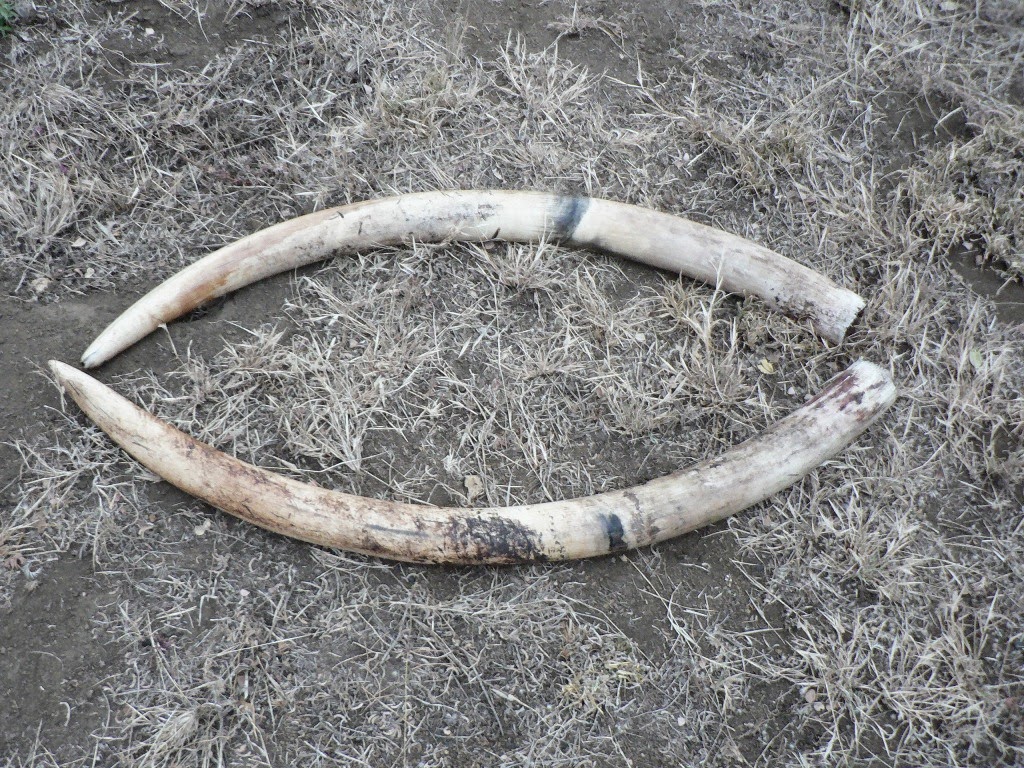
MWCT Rangers found old elephant tusks during a security patrol in Kuku in a dry riverbed. The tusks were heavily degraded and estimated to be more than 5 years old. The tusks were most likely buried by poachers in the past, as there were no signs of an elephant carcass apart from the tusks.

Old elephant tusks that were discovered by MWCT Rangers during a security patrol
MWCT Rangers found a young abandoned zebra while on patrol. The zebra was in healthy condition and so it was decided to leave it in the filed so that it can hopefully reunite with its' family. Survival rates of orphan zebras in captivity are very low, hence the decision to leave it in the wild.

The young abandoned zebra found by MWCT Rangers