Showing posts with label KWS. Show all posts

Saturday, July 26, 2014

Conservation Program Update: Nanumyak Helps to Recover Ivory!

Some really wonderful news from our Conservation team! We had noticed that one of our female collared lions Namunyak had not moved for 2 days, as seen on our GPS map. She had been up in the cloud forest high up in the Chyulu Hills in one position. We were slightly uncomfortable with it and feared that she might been caught in a poachers snare or that something had happened to her.

The beautiful Namunyak (right)

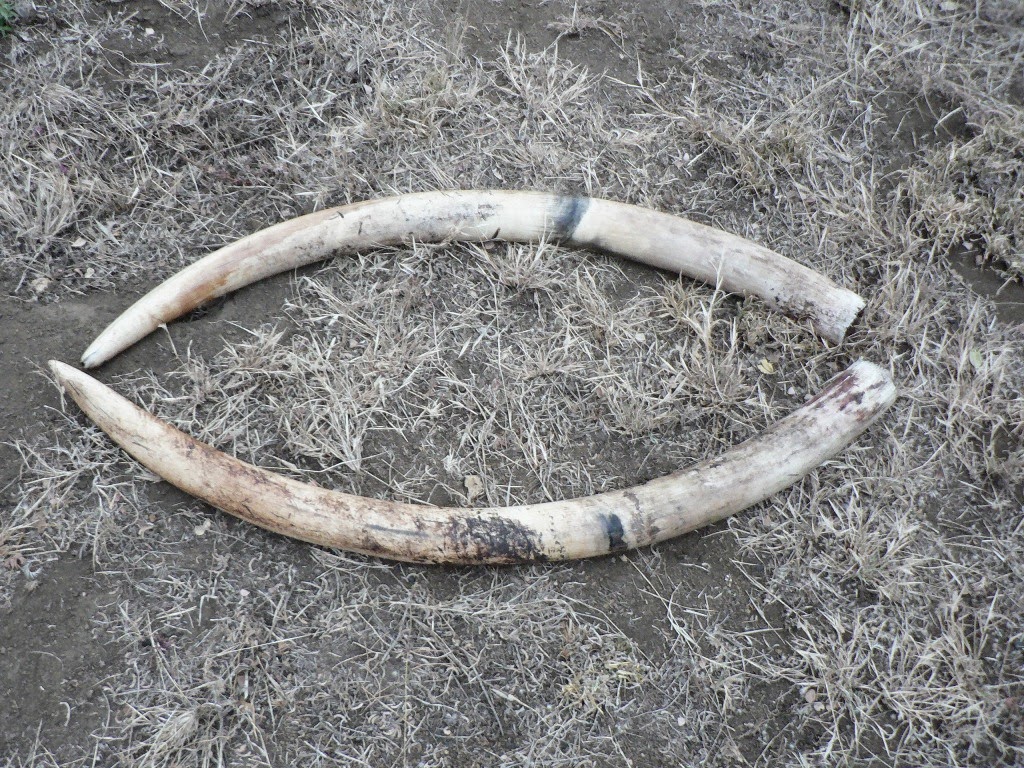
So we arranged an operation one morning last week with the rangers and tracked into the forest to the place we last received a GPS location point from her collar. Once we got to the place we smelled a carcass... and heard a soft growl a couple of metres away in the dense bush. On closer investigation we found it... a carcass of a big elephant! We were so relieved to know that Namunyak was actually doing just fine and that the reason for her t be in one position for two days was because she and her group were feasting on an elephant carcass!

Head Ranger Muterian with the removed tusks

The carcass was about a week old and already partially eaten by the lions so we could not determine the cause of death. It is unlikely that Namunyak and her group killed it. However, the tusks were still intact so we removed them to hand over to Kenya Wildlife Service.


This is just another example that we are very proud of to emphasize how the lion collars assist us in our day to day conservation work!

Wednesday, April 23, 2014

MWCT President in New York

Last week, Maasai Wilderness Conservation Trust President, Samson Parashina, returned from a 10 day journey to the United States. Organized by the Kenya Tourism board, Samson travelled along with a group of others for the purposes of spreading a specific message of Kenya, tourism, and conservation, to the USA.

MWCT President - Samson Parashina
Samson was a Community Ambassador on this journey to the USA, representing the Maasai community of Kenya (the Southern region). Others in the group included: a second Community Ambassador representing the Turkana (Northern) region of Kenya, there was a representative from the Kenya Wildlife Service, and there were a few representatives from the Kenya Tourism Board.

The representatives from Kenya at US News & World Report
Together with all of the individual presentations given, the message that this group wanted to provide to its' audience emphasized that visitors to these particular communities in Kenya (Maasai and Turkana were the specific examples), are making a tremendously positive impact on both the communities, and the environment. Samson shared the many success stories of the Maasai Wilderness Conservation Trust (Wildlife Pays Program, tourism partnership with Campi ya Kanzi, the Simba Scout Program, the Maasai Olympics) and how tourism, and visitors has allowed this organization to succeed and flourish within the community.

In front of Fordham University
Whilst in the US, Samson had the opportunity to share this message to: The UNDP (United Nations Development Program) in New York, Fordham Law School in New York, 70+ Journalists from in and around the New York area, National Geographic Traveller, The US News/World Report, the Smithsonian Magazine, and many many more.

At National Geographic Traveller
This journey was not only essential for establishing a positive image for tourism in Kenya the particular regions represented; but also to fully communicate that conservation and tourism CAN and WILL work together. Samson emphasized this passionately on his journey, through examples of what has happened, and what is currently going on here right now, on Kuku Group Ranch.

Saturday, December 21, 2013

Lion Collaring Expedition - Aftermath

Our conservation team caps off the lion collaring story with one final post.

The next day, Dr. Poghon left MWCT because of other obligations, but we still had one female collar left. The coming week, we will try to set the date for one of two more collaring nights to collar one more lioness.

The collaring operation was quite intense, but we feel that it went very well, and the team is happy and feeling confident to collar one more female within the next few weeks!

The Simba Scouts have already been out tracking "their" new lions with great enthusiasm. It is with high hopes that the new lion collars with be able to accurately assist in the appropriate conservation measures for the lion population of Kuku Group Ranch; understanding their location, habits, and ranges  will contribute to this.
The new Simba Scouts, Songoi, Orkewa, and Joshua tracking the lions from Orkeri Hill

Wednesday, December 18, 2013

Lion Collaring Expedition - Day Four & Five

We've got updates on the next two days of the lion collaring!

Day four arrived and the entire team had good hopes of putting the remaining 3 collars on lions. The new calling station was close to Iltilal, very close to the position the lions were spotted a day earlier - would have been a good central location on the Group Ranch to collar a lion!

Despite the terrible smell of a 2-day old carcass, and hours of playing distress calls of buffalo and warthog, lions were not observed in the area. We thought we had heard lions roaring in the direction of Campi ya Kanzi earlier in the evening. We moved to this area, but this time did not only play distressed calls of buffalo and pig, but also sounds of territorial males as dominant male lions are known to quickly respond to a potential "intruder".

We suddenly heard a big noise and saw a huge black animal running in the dark towards our cars. It appeared to be a very angry buffalo coming to the rescue of the "buffalo calf in distress" call. Although this created some excitement, the lions that we were looking for did not show up. We decided to move onto our next location; but as the rains set in, the expedition was aborted once again.

Day five is now upon us! This would be the last day of the collaring as the KWS vet had to leave for another job the next day. Experts told us to plan for 8 days to collar 4 lions, but the idea of not managing to collar more than 1 lion in 5 days frightened the team. We tried everything in our means to find and collar lions, not sleeping before 5 a.m. and awake at 8 a.m., and we gathered all our strength to give it one more push!

Full of hope, and a little bit of despair, we decided on an area between lake Olpakai and Oltiasika. Some of our Simba Scouts managed to find evidence of lion tracks, even as they were largely washed away by the rains. We were sure there must be lions in the area.

After about 3 and a half hours sitting quietly in the care patiently waiting for the lions to show up, we started to whisper about where to go next as the current location seemed not to be so successful. It was decided to play the buffalo calve in distress one more time before we left. The soundtrack is about 7 minutes long, and on the 6th minute we suddenly heard the growl of a lion that has been darted! Instant excitement!

We were extremely relieved that at last a lion showed up! While searching for the lion, the vet told us over the radio that we were to be looking for a female. When we found the sedated lioness, we saw a male lion laying in ambush next to the sedated lioness waiting for us to come out of the car.

We asked the vet to try to also dart this male lion, because even though they were from the same pride, they will have very different behaviour and movement patterns. Males have larger home rangers and will leave females from time to time to go on territorial patrols, while females usually have smaller home rangers and move less. Furthermore, this would increase the safety of the team trying to collar the lioness.

After a wild chase, the KWS vet managed to dart the lion from the car. When this male was darted, we heard a loud roar and asked Dr. Poghon whether there was possible a third lion in the area - but he assured us he darted the lion that made the noise. The sedated lion was taken into the KWS car and later placed next to its sedated companion.

Oldere and Ormaoi
On close inspection, we noticed that the female was quite muscular and appeared to have male "parts". This was one of the famous mane-less males of Tsavo! These two brothers were moving together as a bachelor group. We decided there was no reason to collar both males of such a group as they might stay together for years. The collar was placed on the one with the man, as it is mostly likely dominant over his mane-less brother. The male collar was far too big to fit properly, so we decided to put on a female collar. The two brothers were named Ormaoi (meaning part of a twin in Maa) and Oldere (refers to grey - whitish colour of the lions coat).

After measuring and treating the lions with necessary health boosters, the antidote was given. To our surprise, after just a few minutes, the mane-less male jumped up and ran away in the darkness - - nobody saw that coming!

Then suddenly the silhouette of a big lion with a full mane appeared in the distance. Seconds later the big maned lion attacked the still partly sedated maneless male, while its brother was still asleep in front of out car. We suspected the young brothers to have come into the territory of the big male who was now investigating our calling station. We told the vet to quickly dart the big male before it could seriously injure the partly sedated young mane-less male.

Lorpolosie fast asleep!
Another wild case resulted in the vet also darting the big male! As a car arrived to watch over the other 2 males, another car managed to find the newly darted big male lion; he was considerably bigger than the others and estimated to be 8 years old. He was in the company of a female lion with 3 - 4 7 month old cubs. The lioness quickly ran off with her cubs to take coverage in the nearby lava.

Measuring the canine length of Lorpolosie - 5.5 cm
The decision was made to also collar this big dominant male with the big male collar. After measurements were taken, this big male was moved about 2 kilometres away to ensure that the fighting males would not immediately meet each other after recovery from the sedation. This male was known by the Simba Scouts, and was named Lorpolosie, meaning "boundaries". He has a large territory on Kuku Group Ranch, but also extends onto neighbouring group ranches.

Translocating Lorpolosie 2 km away so the 2 other males would not attack him
We received a report that the maneless male came back to have a look its collared brother, as he recovered after 30 minutes and left together into the bush. Keeping a watch on the 2nd collared male lion, the other MWCT vehicle moved onto the second calling station. Unfortunately by this time it was quite late (4:30 a.m.) and we did not manage to call any lions at this last position of the evening.

Conservation Managers (Lana & Dirk) with Simba Scouts and Simba Scout Coordinator 

Wow - what a couple of days it has been!

Thursday, November 21, 2013

Conservation Program Update - Summary of Efforts

We have just recently compiled our quarterly report for the MWCT Conservation Program efforts. MWCT Community Wildlife Rangers have been hard at work patrolling Kuku Group Ranch, and have provided a summary of incidents for July, August, and September.

Through the employment of nearly 100 community Rangers and Simba Scouts, we aim to continually prevent illegal wildlife activity, reduce human/wildlife conflict, and monitor the impacts on the biodiversity here on Kuku Group Ranch.

During the third quarter of 2013, we are happy to announce that no elephants were killed on the Group Ranch. Zero tusks were retrieved by poachers during this time, and no elephants were injured by spears - all very positive news!
This map indicates different ranger sectors during security patrols on Kuku Group Ranch.
As you can see, the sectors in the Chyulu Hills (top right corner) have done an
excellent job patrolling to curb poaching!
One lion was killed by a Maasai warrior in Olorika this quater. The lions were predating on a cow, so the warriors proceeded to hunt it. A MWCT team of Simba Scouts, Rangers, and community elders ventured out in attempts to stop the hunt from occurring, but unfortunately they were unsuccessful.

Fortunately, no hyena or leopards were killed, and one lion hunt was prevented from occurring, and 10 arrests took place by MWCT Rangers for the purposes of: illegal bushmeat poaching, illegal charcoal burning and bushlogging, and illegal giraffe poaching.
---

Numerous forms of community outreaches took place by Maasai Wilderness Conservation Trust staff this quarter. They are as follows:

A community outreach was organized after an attempted lion hunt in Kuku village this quarter. The Group Ranch officials, chiefs, the Kenya Wildlife Service community warden, the district police, and MWCT spoke out to community members against lion hunts.  They warned the community that lion hunts will not be tolerated and that it is a criminal offence to kill wildlife.

It is this vast ecosystem that we are working so hard to protect
On August 31, community members from all over Kuku Group Ranch gathered at the Chyulu Conservation and Research Centre to celebrate the winning of the UNDP Equator Prize for grass roots initiatives. Representatives from UNDP, KWS, and the group ranch officials gave speeches on the importance of conservation, community engagement, and congratulated MWCT on its successes.

The preparation for Wildlife Pays payouts in every zone has finished. At the end of this quarter, a MWCT team of conservation, health, and education staff will plan to visit the whole of Kuku Group Ranch and talk to the community about the goals of MWCT and to raise further support for our efforts within the community - a crucially important aspect in the mobilization of knowledge to community members to further increase buy-in to the Trust programs.
---
Moreover, the Wildlife Pays program was busy this quarter. There was a total of 334 wildlife predation incidents reported. The majority of these incidents were due to hyena predation, followed by jackal, and cheetah.
The cheetah - a major stakeholder in livestock predation
A total of 460 heads of livestock predated were reported (cows, goats, sheep, and donkeys). The majority of these livestock were killed by hyena, then by lion, cheetah, and jackal.

The second highest predator to livestock on Kuku Group Ranch
The total value of the payout towards these incidents was 1 728 200 Ksh. Hyena were responsible for 50.9% of the compensation paid, 21.4% to jackal predation, and 9% for lion predation.

Wednesday, August 7, 2013

Community Ranger News

Time for another Conservation Program update from the Maasai Wilderness Conservation Trust!  This week we'd like to share our pride at some of the recent accomplishments of our Community Rangers team and their recent activities.  It's been a great few months for the Ranger program and we're excited for all the great work they've been doing.

Head Ranger Muterian Ntanin leads his fellow commanders on parade at Manyani.
First a big congratulations to our Head Ranger, Operations Commander Muterian Ntanin.  Muterian recently completed his Company Commanders Training Course at the Kenya Wildlife Services Law Enforcement Academy in Manyani.  It's an honor just to be selected to participate in the training course, but Muterian not only did that but finished #3 in a class of 28 trainees.  The skills and leadership training he received at Manyani are invaluable, and his accomplishments and leadership have already inspired the rest of our Rangers to work hard and continue to improve.

A unit of MWCT Community Rangers standing proud at attention.
Our Rangers have also been increasing their patrol distances and making arrests more frequently, both of which are instrumental in deterring illegal activity around the area.  Our Rangers recently rescued an elephant from poachers and arrested three of them; later in the week they arrested four more poachers for illegally killing animals for sale as bush meat.  These arrested poachers are turned over to the Kenya Wildlife Services authorities, where they will face jail sentences and fine that were recently made much stiffer by the Kenyan parliament.  

The Gordon family from Chicago visited the Trust and brought vital supply donations.
Finally, we want to stress again the importance of MWCT's relationship with tourism partner Campi ya Kanzi to helping our programs grow and succeed.  Recently the Gordon family, tourists on holiday at Campi ya Kanzi, brought with them assorted supplies to donate to our Rangers, including two pairs of binoculars and a camera.  These donations are essential to the program's success; other needed items include GPS units, backpacks, water bottles, and rechargeable batteries.

Friday, March 22, 2013

MWCT Report on Lion-Killing Incident

In February a lion was killed in Kuku Group Ranch in reaction to an incident of lion-livestock predation for the first time in more than three years. The lioness killed was named Nosero (Maa for thick cover after the lava field forests that were her favorite hiding places) was well-known to MWCT and Campi ya Kanzi -- in 2007 she was collared for the first time and was since then has been frequently tracked by MWCT Simba Scouts; her movements, behavior and reproduction history were well-known and documented.

The incident in which Nosero was killed was very unfortunate. Early on the morning of February 19th, a party of young morani (Maasai warriors) departed on a traditional lion hunt to kill the lion responsible for killing a lost cow the day before. The hunt was planned at night and sadly MWCT was not alerted in time to respond. Unfortunately, Nosero and her three cubs were found feeding on the cow carcass when the morani arrived; Nosero and two cubs were killed. The other cub was able to escape.

Nosero shown with her radio collar.
Even more unfortunately, one of the Maasai warriors was severely injured during this hunt and tragically passed away before he could be transported to the Iltilal health center. It had been over three years since a lion was killed by Maasai on Kuku and more than thirty since a human life was lost in this community due to a lion hunt.

In weeks prior to the fatal hunt there had been a sharp rise in planned lion hunts, with hunts prompted by nearly every incident of lion-livestock predation. Since the implementation of Wildlife Pays, MWCT's wildlife protection and livestock compensation program, there has been a marked decline of such hunts as the community embraced the reliability of compensation for losses and the increased economic benefit of tourism. However, this year a significant cultural moment within the community, the initiation of a new warrior age set, stressed this happy partnership with new pressures.

MWCT Rangers, Verifying Officers, Simba Scouts, and Kenya Wildlife Services intervened to stop twelve hunts during 2012, but nine hunts were already mounted in under two months of 2013. Several meetings were held with the new Maasai warriors and community elders, but despite these efforts to convince the morani to abandon the hunts, they persevered and killed Nosero before MWCT could be alerted.

MWCT officers speak to morani while halting a lion hunt in late 2012.
Any time we fail to stop the unnecessary killing of even one animal, we are greatly saddened. But it is important to place this isolated event in context. Two years before Wildlife Pays was implemented, in 2005, an average of nine or ten lions were being killed on Kuku Group Ranch per year. Since Wildlife Pays began the number of lions killed has decreased dramatically; with only five killings in seven years. Overall, the human-caused lion mortality rate decreased 92%.

Additionally, 2013 was widely anticipated to be an extremely challenging year due to the cultural significance of a new warrior age set being inducted. Traditionally, this is when many lions are killed throughout the ecosystem by newly minted warriors eager to prove their manhood through a traditional hunt. In February Prior to the incident on Feb. 19th in which Nosero was killed, MWCT and KWS prevented six lion hunts; two more were stopped in January. From this perspective, the killing of Nosero and her cubs was the only loss in a month that without MWCT's intervention may have seen a dozen lions killed.

MWCT's Simba Scouts received GPS training in late 2012 to become more effective in the field. 
Finally, Nosero herself is testament to the impact of our programs. The lifespan of lions in the wild is between 10-15 years; Nosero reached the age of twelve last year. This is especially significant considering she lived outside a national park in a largely human-dominated landscape. In the course of her long life, this lioness preyed on cattle several times and would have been hunted each time if not for Wildlife Pays.

Over her twelve years she gave birth to five litters with fifteen cubs total, so MWCT's efforts allowed this single lioness to add nine lions (three cubs were killed by fellow lion) to the local population. While saddened by any loss, we consider Nosero's life a shining example of how MWCT's work is assisting the recovery of the Tsavo-Amboseli lion population.

Monday, January 7, 2013

The Year in Conservation

With the year 2012 having recently come to a close, here's a quick recap of the major achievements of MWCT's Conservation Program over the past twelve months.  We experienced major achievements and successes on local, regional, and even international levels.  With your continued support and enthusiasm, we can make 2013 even more successful!

Maasai warriors listen to MWCT verifying officers explaining our Wildlife Pays program.

Local Level
  • Our 8 Simba Scouts received training in advanced data collection methods and GPS use
  • 7 lion hunts were halted by MWCT verifying officers and Rangers this year; only one lion was speared by Maasai warriors in self-defense while it was preying a cow
  • MWCT established regular data sharing (lion observations and camera trap recordings) with nearby eco-tourism lodge Campi ya Kanzi
  • 21 arrests were made by our Community Rangers this year
    • 4 for elephant poaching
    • 4 for bushmeat poaching
    • 5 for illegal charcoaling
    • 2 for forest destruction
    • 6 for sandalwood logging
  • We developed and implemented an environmental education curriculum for use in local schools to create conservation awareness and support; our presentations were given to more than 800 students
  • 28 conservation outreaches were held in 16 different locations across Kuku Group Ranch, reaching more than 4200 residents through community meetings, discussions, and environmental film screenings
  • Our Wildlife Pays program was under its compensation cap for all four quarters of 2012, indicating not only successful management, but also better husbandry by the Maasai
  • In collaboration with multinational engineering firm AECOM, MWCT is developing a holistic water management plan for Kuku Group Ranch.  This project will include a wetland restoration project and the construction of pit latrines in several communities, as well as providing the Maasai with clean water sources
  • Water use and discharge of springs in the Olpusare-Moilo farming area were recorded and 47 wells were mapped to enhance the Kuku Group Ranch water system model created by AECOM

A Maasai moran participates in the spear-throwing portion of the inaugural Maasai Olympics.
Regional Level
  • In collaboration with the Maasailand Preservation Trust and the Amboseli Trust for Elephants, we organised the inaugural Maasai Olympics.  Intended to promote Maasai culture and warrior skills through a sports competition rather than traditional methods such as lion killing, the event was a great success
  • Building on our memorandum of understanding with Kenya Wildlife Services (KWS), 8 joint patrols were conducted and KWS assisted with four arrests by our Rangers.  We also worked with KWS to expand data and information sharing regarding conservation efforts in the region
  • 44 MWCT Community Rangers received professional KWS Ranger training
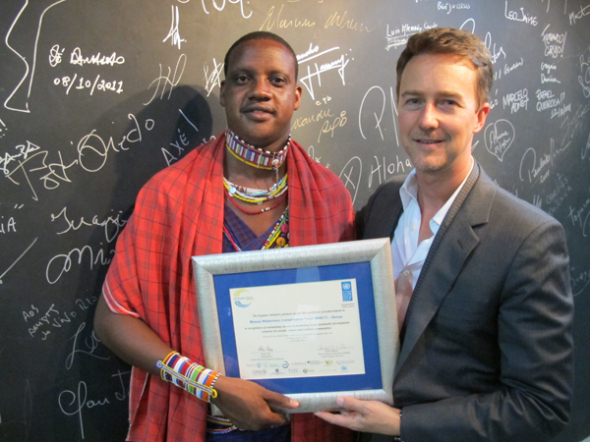
Samson receiving his Champion of the Earth award from MWCT friend and actor Edward Norton.

International Level
  • This summer at Rio+20 MWCT won the UNDP's 2012 Equator Prize and MWCT President Samson Parashina was named a UNDP Champion of the Earth for leading community efforts to conserve the Tsavo-Amboseli ecosystem
  • We collaborated with the Zoological Society of London to develop a new wildlife monitoring protocol