Showing posts with label Wildlife Pays. Show all posts

Thursday, August 7, 2014

Conservation Program Update - Quarterly Success

Our Conservation Team has compiled its' quarterly successes and accomplishments to share with you on our blog! Enjoy reading up on the following tremendous accomplishments from the past couple of months!

Community Rangers:

A deceased elephant was found by 2 school boys herding goats. The school boys immediately informed MWCT Community Rangers about the elephant. The rangers went to the site and found a fresh carcass of an elephant with its tusks still present. MWCT Rangers removed the tusks and handed it over to KWS in Komboyo. After a post mortem was completed, it was determined the death was due to a poisoned spear, which suggests poaching. MWCT Rangers are now investigating the incident!

Our Rangers were informed by a community member from Inkisanjani about poachers planning to poach wildlife on Kuku Group Ranch. The rangers managed to successfully set an ambush and captured 2 of the 3 poachers and impounded 2 motorbikes and bushmeat.

Map of Kuku Group Ranch indicating the patrol effort and areas covered by the different ranger sectors during their security foot patrols from April to June 2014
Lion Monitoring & Simba Scouts:

During this quarter, a detailed lion population survey was conducted! The current estimated resident lion population on Kuku Group Ranch is 32 (14 adults and 18 sub-adults/cubs)!

Namunyak in the company of two adult lionesses and cubs

Of these, 5 lions are collared. These lions are monitored closely by the Simba Scouts on a daily basis. In the event that one of these lions moves into an area close to livestock or bomas, the Simba Scouts will warn the community and herders to watch out and avoid these areas in order to prevent conflict which may lead to the retaliatory killing of lions! A wonderful tool for us!

Lion movement of the 2 GPS collared lion (Yellow = Namunyak; Pink = Neluai)

Wildlife Pays:

Our Wildlife Pays Program this quarter was very busy! A total of 259 incidents of livestock predation were recorded; most incidents being due to hyena, followed by cheetah and then jackal. The total value of the payout was 1,552,400 Ksh.

Number of heads of livestock killed per wildlife species in this past quarter
Community Outreach:

Wildlife Pays Outreach - In these meetings, MWCT's program coordinators spoke to the community about the benefits that MWCT is giving to the community, and their role in protecting their natural resources and wildlife in turn!

MWCT and Campi ya Kanzi Staff Meeting - A meeting with all of the staff of both organizations was held at the beginning of June. During this meeting, the achievements of 2013 were announced and future MWCT projects and goals were discussed

Environmental Education Outreach in Inkisanjani and Olkaria - MWCT Outreach Officer, Joseph Lairumbe, went to Inkisanjani and Olkari Primary School to give an environmental education lesson (Know Your Wildlife) to the school children. These lessons were attended by 200 and 250 pupils respectively! The children greatly enjoyed learning about wildlife - and they were encouraged to protect the wildlife and other natural resources in their area

Moran Chief Initiation Ceremony - On the 3rd of May, Peter ole Sombol, was initiated as the leader of the Maasai warrior age-set from the Iltilal Manyatta. MWCT Program Coordinators and Management attended the ceremony and had a brief meeting with the new chief after the ceremony. Peter is in full support of conservation and the work of MWCT and is motivated to teach and encourage his fellow warriors about the value of wildlife and wildlife protection of Kuku Group Ranch!

MWCT and Campi ya Kanzi staff

Monday, April 21, 2014

Conservation Program Update - Wildlife Pays Success Story

Although many people come to spend and visit a significant amount of time in Maasai land, many do not understand the importance and value of livestock herds as well as the value of living in the traditional Maasai way.

Recently, our Conservation Program became aware of a scenario in which 5 grown cow calves were killed near Olpukai swamp by lions in the daylight, with the herders present and nearby. Two lions were involved in the killing (one of the male collared lions and his companions), and the herders were standing very nearby, but unfortunately could not herd the calves away quickly enough to save them.

Olpukai Swamp - location of the incident
Historically and traditionally, the reaction would have resulted in a direct killing in retaliation, or a pursue of a lion hunt of these two lions. However, it is very clear that there is some major success to report in this story. The Wildlife Pays program with MWCT seeks to teach the Maasai that by not killing lions, by saving them in the ecosystem, that they will receive benefits. Through this program, with any loss of livestock due to predation with no negligence on the side of the herder and the boma (boma being a certain size, and herder acting appropriately) a compensation is paid to the owner of the affected livestock.

Livestock and wildlife grazing and living simultaneously at the swamp
To many Maasai, livestock is the sole source of income for the entire family. In this scenario, 5 cows is worth a compensation payment of 100 000 KSH. For this family to have a loss of five animals it was a very large detriment, despite the repayment. It is a large success for the Wildlife Pays program to know that the Maasai are compliant in not killing these lions, as they are aware of the negative consequences of a lion killing on themselves and their community,  as well as the potential economic compensation they may receive.

Thursday, November 21, 2013

Conservation Program Update - Summary of Efforts

We have just recently compiled our quarterly report for the MWCT Conservation Program efforts. MWCT Community Wildlife Rangers have been hard at work patrolling Kuku Group Ranch, and have provided a summary of incidents for July, August, and September.

Through the employment of nearly 100 community Rangers and Simba Scouts, we aim to continually prevent illegal wildlife activity, reduce human/wildlife conflict, and monitor the impacts on the biodiversity here on Kuku Group Ranch.

During the third quarter of 2013, we are happy to announce that no elephants were killed on the Group Ranch. Zero tusks were retrieved by poachers during this time, and no elephants were injured by spears - all very positive news!
This map indicates different ranger sectors during security patrols on Kuku Group Ranch.
As you can see, the sectors in the Chyulu Hills (top right corner) have done an
excellent job patrolling to curb poaching!
One lion was killed by a Maasai warrior in Olorika this quater. The lions were predating on a cow, so the warriors proceeded to hunt it. A MWCT team of Simba Scouts, Rangers, and community elders ventured out in attempts to stop the hunt from occurring, but unfortunately they were unsuccessful.

Fortunately, no hyena or leopards were killed, and one lion hunt was prevented from occurring, and 10 arrests took place by MWCT Rangers for the purposes of: illegal bushmeat poaching, illegal charcoal burning and bushlogging, and illegal giraffe poaching.
---

Numerous forms of community outreaches took place by Maasai Wilderness Conservation Trust staff this quarter. They are as follows:

A community outreach was organized after an attempted lion hunt in Kuku village this quarter. The Group Ranch officials, chiefs, the Kenya Wildlife Service community warden, the district police, and MWCT spoke out to community members against lion hunts.  They warned the community that lion hunts will not be tolerated and that it is a criminal offence to kill wildlife.

It is this vast ecosystem that we are working so hard to protect
On August 31, community members from all over Kuku Group Ranch gathered at the Chyulu Conservation and Research Centre to celebrate the winning of the UNDP Equator Prize for grass roots initiatives. Representatives from UNDP, KWS, and the group ranch officials gave speeches on the importance of conservation, community engagement, and congratulated MWCT on its successes.

The preparation for Wildlife Pays payouts in every zone has finished. At the end of this quarter, a MWCT team of conservation, health, and education staff will plan to visit the whole of Kuku Group Ranch and talk to the community about the goals of MWCT and to raise further support for our efforts within the community - a crucially important aspect in the mobilization of knowledge to community members to further increase buy-in to the Trust programs.
---
Moreover, the Wildlife Pays program was busy this quarter. There was a total of 334 wildlife predation incidents reported. The majority of these incidents were due to hyena predation, followed by jackal, and cheetah.
The cheetah - a major stakeholder in livestock predation
A total of 460 heads of livestock predated were reported (cows, goats, sheep, and donkeys). The majority of these livestock were killed by hyena, then by lion, cheetah, and jackal.

The second highest predator to livestock on Kuku Group Ranch
The total value of the payout towards these incidents was 1 728 200 Ksh. Hyena were responsible for 50.9% of the compensation paid, 21.4% to jackal predation, and 9% for lion predation.

Friday, March 22, 2013

MWCT Report on Lion-Killing Incident

In February a lion was killed in Kuku Group Ranch in reaction to an incident of lion-livestock predation for the first time in more than three years. The lioness killed was named Nosero (Maa for thick cover after the lava field forests that were her favorite hiding places) was well-known to MWCT and Campi ya Kanzi -- in 2007 she was collared for the first time and was since then has been frequently tracked by MWCT Simba Scouts; her movements, behavior and reproduction history were well-known and documented.

The incident in which Nosero was killed was very unfortunate. Early on the morning of February 19th, a party of young morani (Maasai warriors) departed on a traditional lion hunt to kill the lion responsible for killing a lost cow the day before. The hunt was planned at night and sadly MWCT was not alerted in time to respond. Unfortunately, Nosero and her three cubs were found feeding on the cow carcass when the morani arrived; Nosero and two cubs were killed. The other cub was able to escape.

Nosero shown with her radio collar.
Even more unfortunately, one of the Maasai warriors was severely injured during this hunt and tragically passed away before he could be transported to the Iltilal health center. It had been over three years since a lion was killed by Maasai on Kuku and more than thirty since a human life was lost in this community due to a lion hunt.

In weeks prior to the fatal hunt there had been a sharp rise in planned lion hunts, with hunts prompted by nearly every incident of lion-livestock predation. Since the implementation of Wildlife Pays, MWCT's wildlife protection and livestock compensation program, there has been a marked decline of such hunts as the community embraced the reliability of compensation for losses and the increased economic benefit of tourism. However, this year a significant cultural moment within the community, the initiation of a new warrior age set, stressed this happy partnership with new pressures.

MWCT Rangers, Verifying Officers, Simba Scouts, and Kenya Wildlife Services intervened to stop twelve hunts during 2012, but nine hunts were already mounted in under two months of 2013. Several meetings were held with the new Maasai warriors and community elders, but despite these efforts to convince the morani to abandon the hunts, they persevered and killed Nosero before MWCT could be alerted.

MWCT officers speak to morani while halting a lion hunt in late 2012.
Any time we fail to stop the unnecessary killing of even one animal, we are greatly saddened. But it is important to place this isolated event in context. Two years before Wildlife Pays was implemented, in 2005, an average of nine or ten lions were being killed on Kuku Group Ranch per year. Since Wildlife Pays began the number of lions killed has decreased dramatically; with only five killings in seven years. Overall, the human-caused lion mortality rate decreased 92%.

Additionally, 2013 was widely anticipated to be an extremely challenging year due to the cultural significance of a new warrior age set being inducted. Traditionally, this is when many lions are killed throughout the ecosystem by newly minted warriors eager to prove their manhood through a traditional hunt. In February Prior to the incident on Feb. 19th in which Nosero was killed, MWCT and KWS prevented six lion hunts; two more were stopped in January. From this perspective, the killing of Nosero and her cubs was the only loss in a month that without MWCT's intervention may have seen a dozen lions killed.

MWCT's Simba Scouts received GPS training in late 2012 to become more effective in the field. 
Finally, Nosero herself is testament to the impact of our programs. The lifespan of lions in the wild is between 10-15 years; Nosero reached the age of twelve last year. This is especially significant considering she lived outside a national park in a largely human-dominated landscape. In the course of her long life, this lioness preyed on cattle several times and would have been hunted each time if not for Wildlife Pays.

Over her twelve years she gave birth to five litters with fifteen cubs total, so MWCT's efforts allowed this single lioness to add nine lions (three cubs were killed by fellow lion) to the local population. While saddened by any loss, we consider Nosero's life a shining example of how MWCT's work is assisting the recovery of the Tsavo-Amboseli lion population.

Monday, January 7, 2013

The Year in Conservation

With the year 2012 having recently come to a close, here's a quick recap of the major achievements of MWCT's Conservation Program over the past twelve months.  We experienced major achievements and successes on local, regional, and even international levels.  With your continued support and enthusiasm, we can make 2013 even more successful!

Maasai warriors listen to MWCT verifying officers explaining our Wildlife Pays program.

Local Level
  • Our 8 Simba Scouts received training in advanced data collection methods and GPS use
  • 7 lion hunts were halted by MWCT verifying officers and Rangers this year; only one lion was speared by Maasai warriors in self-defense while it was preying a cow
  • MWCT established regular data sharing (lion observations and camera trap recordings) with nearby eco-tourism lodge Campi ya Kanzi
  • 21 arrests were made by our Community Rangers this year
    • 4 for elephant poaching
    • 4 for bushmeat poaching
    • 5 for illegal charcoaling
    • 2 for forest destruction
    • 6 for sandalwood logging
  • We developed and implemented an environmental education curriculum for use in local schools to create conservation awareness and support; our presentations were given to more than 800 students
  • 28 conservation outreaches were held in 16 different locations across Kuku Group Ranch, reaching more than 4200 residents through community meetings, discussions, and environmental film screenings
  • Our Wildlife Pays program was under its compensation cap for all four quarters of 2012, indicating not only successful management, but also better husbandry by the Maasai
  • In collaboration with multinational engineering firm AECOM, MWCT is developing a holistic water management plan for Kuku Group Ranch.  This project will include a wetland restoration project and the construction of pit latrines in several communities, as well as providing the Maasai with clean water sources
  • Water use and discharge of springs in the Olpusare-Moilo farming area were recorded and 47 wells were mapped to enhance the Kuku Group Ranch water system model created by AECOM

A Maasai moran participates in the spear-throwing portion of the inaugural Maasai Olympics.
Regional Level
  • In collaboration with the Maasailand Preservation Trust and the Amboseli Trust for Elephants, we organised the inaugural Maasai Olympics.  Intended to promote Maasai culture and warrior skills through a sports competition rather than traditional methods such as lion killing, the event was a great success
  • Building on our memorandum of understanding with Kenya Wildlife Services (KWS), 8 joint patrols were conducted and KWS assisted with four arrests by our Rangers.  We also worked with KWS to expand data and information sharing regarding conservation efforts in the region
  • 44 MWCT Community Rangers received professional KWS Ranger training
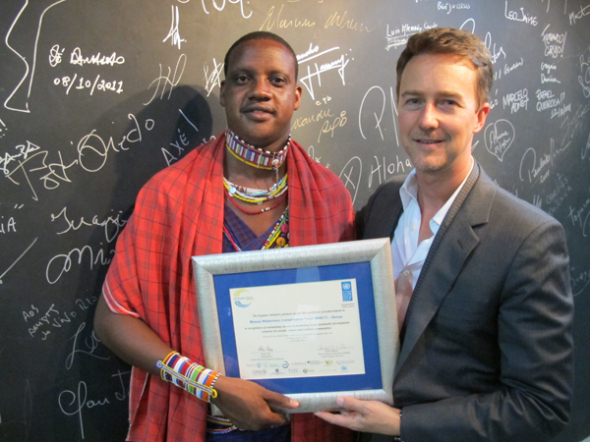
Samson receiving his Champion of the Earth award from MWCT friend and actor Edward Norton.

International Level
  • This summer at Rio+20 MWCT won the UNDP's 2012 Equator Prize and MWCT President Samson Parashina was named a UNDP Champion of the Earth for leading community efforts to conserve the Tsavo-Amboseli ecosystem
  • We collaborated with the Zoological Society of London to develop a new wildlife monitoring protocol

Wednesday, December 19, 2012

Conservation Update - Lion Hunt Stopped

Today's news is about one of the scariest parts of MWCT's Conservation Program - but also one of its most important.  The traditional response to livestock predation of Maasai cattle and goats has been to hunt and kill the offending lion, hyena, or leopard.  With the introduction of our Wildlife Pays initiative, MWCT has sought to change this paradigm by partial compensation to herders for verified losses, thereby helping the Maasai to see these endangered predators as a potential source of income rather than a nuisance to be eliminated.

A Maasai zone elder speaks with the warriors, convincing them to abandon their lion hunt.
Two weeks ago our system was tested to the extreme, as a pride of seven lions killed a big bull owned by a Maasai.  He was understandably very upset, as he had planned to sell the bull at market the following weekend to help pay for his sick child's treatment.  News quickly spread, and a group of 26 morani, or Maasai warriors, gathered with dogs and spears to track and kill the lions.

Luckily we also heard the news, and our Wildlife Pays verifying officer traveled to the scene as quickly as he could to attempt to calm them.  Finding the warriors nearly in a frenzy, he called for backup and we sent several MWCT Rangers, our community outreach area, and the Maasai zone elder of that region.  After a long discussion and much careful pacification on the part of our employees, the warriors were finally convinced to discontinue their hunt and dispersed.

After a long meeting and much convincing, the warriors agreed to disperse and the situation was resolved amicably.
The whole incident, while scary and regrettable, was nonetheless a great success for MWCT's Conservation Program.  It marked the seventh time this year we have been able to successfully stop a lion hunt before a kill was made, compared to just one successful hunt as a result of livestock predation.  Considering that this year was expected to be a particularly volatile one, with many young warriors being initiated, these numbers are a great success.  With your continued support, we can continue our work through projects like these, preserving the heritage of both the wildlife and the Maasai.

Tuesday, September 11, 2012

Conservation Update - Lion Hunt Stopped!

MWCT's Conservation Program operates several initiatives, but one of the most important is called Wildlife Pays.  This program compensates livestock herders for losses to wildlife predation through a rigorous system of certification and monitoring of best practices; by doing so it prevents the killing of predators that would otherwise be the natural reaction to livestock killings.  Wildlife Pays is fully funded by the Conservation Fees payed by visitors to Campi ya Kanzi, a nearby eco-tourism lodge.

Last Wednesday was an excellent testament to the success of Wildlife Pays, as three lions attacked and killed a cow on Kuku Group Ranch.  Angered by the killing, around 50 morani (Maasai warriors) headed out to pursue and kill the lions.  Fortunately our community rangers reacted and were able to intercept the morani before they succeeded in this goal.  After assuring the Maasai warriors the owner would be compensated, they were able to calm them down and persuade them to return to their normal work.


Following this meeting, MWCT rangers certified the killing and verified that it was done by lions, and that the herder was to be compensated for his loss through the Wildlife Pays fund.  Efforts like this, in which the Trust directly intervened and was able to save three lions and make everyone involved happy, are exactly the type of success the Conservation Program of MWCT aims for.  With continued education, hard work, and your support, these successes can become the norm.