Showing posts with label lion hunt. Show all posts

Thursday, March 19, 2015

The 2014 Maasai Olympics: Competing for Change

The 2014 Maasai Olympics took place in mid-December, hosted at Kimana Sanctuary in Kajaido, Kenya. Organized and sanctioned by Big Life Foundation, the Maasai Wilderness Conservation Trust, worked together with  a number of other supporters, sponsors, and and contributors in collaboration to bring together warriors of Kuku, Rombo, Mbirikani, and Olgulului Group Ranches to compete in six different events; rungu throwing, spear throwing, high jump, 200 m sprint, 800 m sprint, and 5 kilometre run.

A moran competes in the high jump competition
The sole purpose of the Maasai Olympics is not only to provide the current warrior age set with a platform to compete with their peers, but more importantly, to emphasize an alternative to the traditional practice of proving manhood - lion killing. This platform was provided to the warriors to utilize traditional skills to "hunt for medals, not for lions".

Gold, Silver, and Bronze Medals
The first competition in 2012 was deemed a huge success, and 2014 was certainly an exciting competition!

Participants of the 5000m competition
The Maasai Wilderness Conservation Trust sponsored the 1st position of the 5000m and 800m to participate in the New York Marathon. The 5000m was a very tense competition... as Kuku was for a large part of the race in the 1st, 3rd, and 4th position. In the last 300m a moran from Mbirikani who was in the 2nd position overtook the Kuku runner and ended up winning the race!

Samson handing over cheque to the winning moran to participate in the 2015 New York Marathon
Overall score of the Olympics: 1st position Mbirikani Manyatta with 16.5 points; 2nd position Olgulului Manyatta with 7.5 points; 3rd position was Kuku Manyatta with 7 points (very close call between 2nd and 3rd position) and in the 4th position was Rombo Manyatta with 5 points total.

Kuku was proudly in the 1st position for Javelin (spear) throwing!


It was an excellent day filled with an extraordinary display of skill, competition, cooperation, and commitment to conservation. To learn more about this tremendous event, you can visit the official Maasai Olympics website here


MWCT Ranger with David Rudisha - Kenyan Gold Medalist

The Scoreboard

Monday, April 21, 2014

Conservation Program Update - Wildlife Pays Success Story

Although many people come to spend and visit a significant amount of time in Maasai land, many do not understand the importance and value of livestock herds as well as the value of living in the traditional Maasai way.

Recently, our Conservation Program became aware of a scenario in which 5 grown cow calves were killed near Olpukai swamp by lions in the daylight, with the herders present and nearby. Two lions were involved in the killing (one of the male collared lions and his companions), and the herders were standing very nearby, but unfortunately could not herd the calves away quickly enough to save them.

Olpukai Swamp - location of the incident
Historically and traditionally, the reaction would have resulted in a direct killing in retaliation, or a pursue of a lion hunt of these two lions. However, it is very clear that there is some major success to report in this story. The Wildlife Pays program with MWCT seeks to teach the Maasai that by not killing lions, by saving them in the ecosystem, that they will receive benefits. Through this program, with any loss of livestock due to predation with no negligence on the side of the herder and the boma (boma being a certain size, and herder acting appropriately) a compensation is paid to the owner of the affected livestock.

Livestock and wildlife grazing and living simultaneously at the swamp
To many Maasai, livestock is the sole source of income for the entire family. In this scenario, 5 cows is worth a compensation payment of 100 000 KSH. For this family to have a loss of five animals it was a very large detriment, despite the repayment. It is a large success for the Wildlife Pays program to know that the Maasai are compliant in not killing these lions, as they are aware of the negative consequences of a lion killing on themselves and their community,  as well as the potential economic compensation they may receive.

Thursday, November 21, 2013

Conservation Program Update - Summary of Efforts

We have just recently compiled our quarterly report for the MWCT Conservation Program efforts. MWCT Community Wildlife Rangers have been hard at work patrolling Kuku Group Ranch, and have provided a summary of incidents for July, August, and September.

Through the employment of nearly 100 community Rangers and Simba Scouts, we aim to continually prevent illegal wildlife activity, reduce human/wildlife conflict, and monitor the impacts on the biodiversity here on Kuku Group Ranch.

During the third quarter of 2013, we are happy to announce that no elephants were killed on the Group Ranch. Zero tusks were retrieved by poachers during this time, and no elephants were injured by spears - all very positive news!
This map indicates different ranger sectors during security patrols on Kuku Group Ranch.
As you can see, the sectors in the Chyulu Hills (top right corner) have done an
excellent job patrolling to curb poaching!
One lion was killed by a Maasai warrior in Olorika this quater. The lions were predating on a cow, so the warriors proceeded to hunt it. A MWCT team of Simba Scouts, Rangers, and community elders ventured out in attempts to stop the hunt from occurring, but unfortunately they were unsuccessful.

Fortunately, no hyena or leopards were killed, and one lion hunt was prevented from occurring, and 10 arrests took place by MWCT Rangers for the purposes of: illegal bushmeat poaching, illegal charcoal burning and bushlogging, and illegal giraffe poaching.
---

Numerous forms of community outreaches took place by Maasai Wilderness Conservation Trust staff this quarter. They are as follows:

A community outreach was organized after an attempted lion hunt in Kuku village this quarter. The Group Ranch officials, chiefs, the Kenya Wildlife Service community warden, the district police, and MWCT spoke out to community members against lion hunts.  They warned the community that lion hunts will not be tolerated and that it is a criminal offence to kill wildlife.

It is this vast ecosystem that we are working so hard to protect
On August 31, community members from all over Kuku Group Ranch gathered at the Chyulu Conservation and Research Centre to celebrate the winning of the UNDP Equator Prize for grass roots initiatives. Representatives from UNDP, KWS, and the group ranch officials gave speeches on the importance of conservation, community engagement, and congratulated MWCT on its successes.

The preparation for Wildlife Pays payouts in every zone has finished. At the end of this quarter, a MWCT team of conservation, health, and education staff will plan to visit the whole of Kuku Group Ranch and talk to the community about the goals of MWCT and to raise further support for our efforts within the community - a crucially important aspect in the mobilization of knowledge to community members to further increase buy-in to the Trust programs.
---
Moreover, the Wildlife Pays program was busy this quarter. There was a total of 334 wildlife predation incidents reported. The majority of these incidents were due to hyena predation, followed by jackal, and cheetah.
The cheetah - a major stakeholder in livestock predation
A total of 460 heads of livestock predated were reported (cows, goats, sheep, and donkeys). The majority of these livestock were killed by hyena, then by lion, cheetah, and jackal.

The second highest predator to livestock on Kuku Group Ranch
The total value of the payout towards these incidents was 1 728 200 Ksh. Hyena were responsible for 50.9% of the compensation paid, 21.4% to jackal predation, and 9% for lion predation.

Wednesday, December 19, 2012

Conservation Update - Lion Hunt Stopped

Today's news is about one of the scariest parts of MWCT's Conservation Program - but also one of its most important.  The traditional response to livestock predation of Maasai cattle and goats has been to hunt and kill the offending lion, hyena, or leopard.  With the introduction of our Wildlife Pays initiative, MWCT has sought to change this paradigm by partial compensation to herders for verified losses, thereby helping the Maasai to see these endangered predators as a potential source of income rather than a nuisance to be eliminated.

A Maasai zone elder speaks with the warriors, convincing them to abandon their lion hunt.
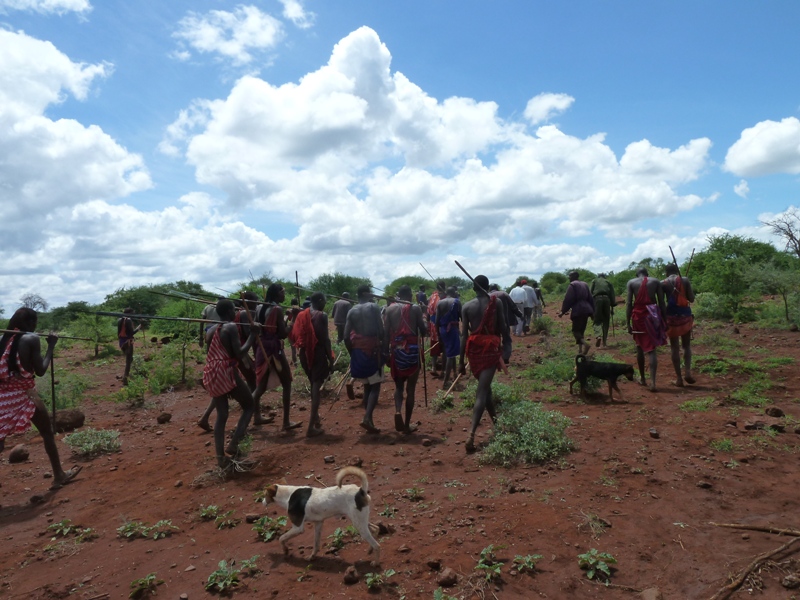
Two weeks ago our system was tested to the extreme, as a pride of seven lions killed a big bull owned by a Maasai.  He was understandably very upset, as he had planned to sell the bull at market the following weekend to help pay for his sick child's treatment.  News quickly spread, and a group of 26 morani, or Maasai warriors, gathered with dogs and spears to track and kill the lions.

Luckily we also heard the news, and our Wildlife Pays verifying officer traveled to the scene as quickly as he could to attempt to calm them.  Finding the warriors nearly in a frenzy, he called for backup and we sent several MWCT Rangers, our community outreach area, and the Maasai zone elder of that region.  After a long discussion and much careful pacification on the part of our employees, the warriors were finally convinced to discontinue their hunt and dispersed.

After a long meeting and much convincing, the warriors agreed to disperse and the situation was resolved amicably.
The whole incident, while scary and regrettable, was nonetheless a great success for MWCT's Conservation Program.  It marked the seventh time this year we have been able to successfully stop a lion hunt before a kill was made, compared to just one successful hunt as a result of livestock predation.  Considering that this year was expected to be a particularly volatile one, with many young warriors being initiated, these numbers are a great success.  With your continued support, we can continue our work through projects like these, preserving the heritage of both the wildlife and the Maasai.