Showing posts with label livestock predation. Show all posts

Thursday, May 1, 2014

Why the Lion Collars?

Recently, Namunyak and her group were around the lava fields close to the Iltilal Village. MWCT Conservation Team is well aware of a regular cattle route passing very close to where her location was. The team sent out the Simba Scouts to go inform these regular herders in the area to herd their livestock away from where Namunyak and her group were. 


Our team wanted to ensure that all precautions were taken to avoid Namunyak and the other lions predating on the livestock, as it may lead to conflict with the community, potentially resulting in a lion hunt. The herders were extremely thankful of this warning from our staff. The Simba Scouts also helped the herders to herd the cows away so that they could graze in a different area where it was safe. 

Many may not truly understand the importance of a lion collar. But this story explains one of the main reasons why they are crucially important. There are many many reasons for collaring a lion, but especially in community land where human-lion conflict is high, it is a very useful tool that can be used to protect the lions. With the collars you can track them and also study their behaviour/movement in relation to human settlements. This information can then be used to mitigate conflict and avoid the lions being killed, such as was done above. Once you understand the behaviour and movement of lions in community land, you can identify high risk areas that herdsmen can avoid. 

Monday, April 21, 2014

Conservation Program Update - Wildlife Pays Success Story

Although many people come to spend and visit a significant amount of time in Maasai land, many do not understand the importance and value of livestock herds as well as the value of living in the traditional Maasai way.

Recently, our Conservation Program became aware of a scenario in which 5 grown cow calves were killed near Olpukai swamp by lions in the daylight, with the herders present and nearby. Two lions were involved in the killing (one of the male collared lions and his companions), and the herders were standing very nearby, but unfortunately could not herd the calves away quickly enough to save them.

Olpukai Swamp - location of the incident
Historically and traditionally, the reaction would have resulted in a direct killing in retaliation, or a pursue of a lion hunt of these two lions. However, it is very clear that there is some major success to report in this story. The Wildlife Pays program with MWCT seeks to teach the Maasai that by not killing lions, by saving them in the ecosystem, that they will receive benefits. Through this program, with any loss of livestock due to predation with no negligence on the side of the herder and the boma (boma being a certain size, and herder acting appropriately) a compensation is paid to the owner of the affected livestock.

Livestock and wildlife grazing and living simultaneously at the swamp
To many Maasai, livestock is the sole source of income for the entire family. In this scenario, 5 cows is worth a compensation payment of 100 000 KSH. For this family to have a loss of five animals it was a very large detriment, despite the repayment. It is a large success for the Wildlife Pays program to know that the Maasai are compliant in not killing these lions, as they are aware of the negative consequences of a lion killing on themselves and their community,  as well as the potential economic compensation they may receive.

Wednesday, December 19, 2012

Conservation Update - Lion Hunt Stopped

Today's news is about one of the scariest parts of MWCT's Conservation Program - but also one of its most important.  The traditional response to livestock predation of Maasai cattle and goats has been to hunt and kill the offending lion, hyena, or leopard.  With the introduction of our Wildlife Pays initiative, MWCT has sought to change this paradigm by partial compensation to herders for verified losses, thereby helping the Maasai to see these endangered predators as a potential source of income rather than a nuisance to be eliminated.

A Maasai zone elder speaks with the warriors, convincing them to abandon their lion hunt.
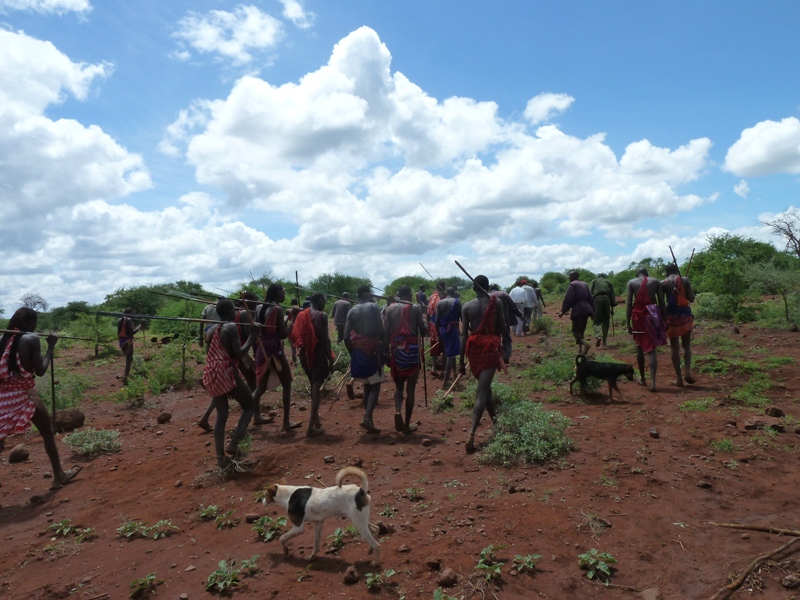
Two weeks ago our system was tested to the extreme, as a pride of seven lions killed a big bull owned by a Maasai.  He was understandably very upset, as he had planned to sell the bull at market the following weekend to help pay for his sick child's treatment.  News quickly spread, and a group of 26 morani, or Maasai warriors, gathered with dogs and spears to track and kill the lions.

Luckily we also heard the news, and our Wildlife Pays verifying officer traveled to the scene as quickly as he could to attempt to calm them.  Finding the warriors nearly in a frenzy, he called for backup and we sent several MWCT Rangers, our community outreach area, and the Maasai zone elder of that region.  After a long discussion and much careful pacification on the part of our employees, the warriors were finally convinced to discontinue their hunt and dispersed.

After a long meeting and much convincing, the warriors agreed to disperse and the situation was resolved amicably.
The whole incident, while scary and regrettable, was nonetheless a great success for MWCT's Conservation Program.  It marked the seventh time this year we have been able to successfully stop a lion hunt before a kill was made, compared to just one successful hunt as a result of livestock predation.  Considering that this year was expected to be a particularly volatile one, with many young warriors being initiated, these numbers are a great success.  With your continued support, we can continue our work through projects like these, preserving the heritage of both the wildlife and the Maasai.